
The Myth-Buster: The Outdated “Downhill” Narrative
For decades, we were told a very specific story about the human brain.
The story claimed that your brain reached its peak in your late 20s. After that, it was a slow, unavoidable slide toward forgetfulness and mental fog.
The medical community called it natural age-related decline. Society called it a senior moment. We were expected to just accept it.
But current research is flipping this narrative on its head.
The latest findings in neuroplasticity suggest that your brain has the potential to remain sharp, adaptive, and highly functional well into your 70s and beyond in many cases.
The decline many people experience is not a biological destiny. It is often influenced by cumulative resource gaps that have gone unaddressed for too many years.
The Science Deep-Dive: The Reality of Neural Plasticity
Your brain is not a static piece of hardware. It is a living, breathing network that is constantly remodeling itself.
This process is known as neuroplasticity. Researchers are actively studying how the adult brain can continue to grow new connections and optimize existing ones.
The key to this process is the availability of specific growth factors and neurotransmitters involved in synaptic signaling and plasticity.
When your brain has the right biological environment, it can support healthy recovery and metabolic balance. It can clear the haze that slows down signal transmission.
This helps explain why your cognitive sharpness can be maintained. It is about providing the prefrontal cortex with the specific environment it needs to thrive rather than just survive.
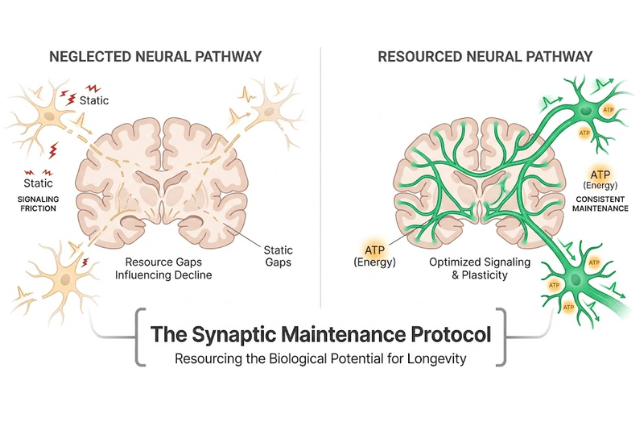
This maintenance reflects underlying biological processes that occur at the cellular level. It requires a steady supply of the building blocks that support signal clarity and neural fluidity.
Early research suggests that targeted nutritional and cognitive support can noticeably shift the experience of cognitive aging.
The ‘Brain Tax’: The Cost of Resource Depletion
Think of your focus like a sophisticated power grid.
As the demands of your professional and personal life increase, the grid requires more maintenance.
However, as we age, our body’s ability to efficiently clear metabolic byproducts may become less efficient. This creates a tax on your focus.

The ‘Survival Guide’: Signs Your Brain Is Fighting for Resources
You need to recognize when your brain is asking for help.
● The Word-Finding Lag: You know the word is there, but the neural pathway feels blocked.
● The Context Slip: You remember the event, but the specific details feel blurred or out of reach.
● The Midday Fade: You start the morning strong, but your focus begins to drop in a measurable way by early afternoon.
● The Decision Fatigue: Simple choices start to feel overwhelming because your working memory is operating with reduced availability.
Many describe the subjective experience of addressing these signs as a reawakening. The friction of daily thinking starts to disappear.
The ‘Neural Resilience Protocol’: A New Standard for Longevity
Many high-performers over 50 move beyond the old wait and see approach. They choose to resource their brain actively.
The Neural Resilience Protocol is based on the understanding that your prefrontal cortex requires specific inputs to maintain peak function.
Alpha GPC and Huperzine A are associated with supporting healthy acetylcholine levels. This is a key neurotransmitter that enables focus and signal clarity.
Ginkgo Biloba may support healthy cerebral circulation. This ensures your brain accesses the oxygen and glucose it needs in real time.
Lion’s Mane and Bacopa Monnieri are associated with the health and maintenance of neural connections. Users report that their mental warm-up period becomes noticeably more efficient.
Phosphatidylserine supports the fluidity of neural membranes. This allows signals to move cleanly, even through the metabolic haze that can accumulate.
L-Theanine supports a state of calm focus. It helps manage the cognitive anxiety that often accompanies a high-demand professional life.
This targeted approach is one of the key mechanisms involved in how high-performers maintain their edge.
The FAQ Reality Check: Science vs. Tradition
Q: Is it really possible to improve focus after 60? Current research into neuroplasticity shows that the brain can continue to optimize its signaling even later in life when supported appropriately.
Q: Why was I told decline was inevitable? Older studies focused on structural changes. Newer research focuses on functional capacity and how we can support it through nutritional and behavioral inputs.
Q: Does stress impact these resource gaps? Absolutely. Chronic stress is one of the primary drivers of resource depletion in the prefrontal cortex. Managing it is essential for long-term clarity.
Customized High-Stakes Conclusion
Imagine the freedom of knowing your best cognitive years might still be ahead of you.
Imagine the confidence of walking into any meeting knowing your focus will remain steady from start to finish.
The downhill narrative is an outdated myth. Your brain is designed for resilience.
The fog you may be feeling is not a life sentence. It is a signal that your brain is operating with reduced availability of the resources it needs to thrive.
When you bridge that gap, you stop managing decline. You start optimizing longevity.