
The Contrast: When Your Mind Starts To Glitch
You were always the one who remembered everything.
The birthdays. The grocery list. The specific detail from a meeting three weeks ago. You were the human calendar for your family and the sharpest mind in the office.
Then, things started to shift.
You walk into a room and forget why you are there. You are in the middle of a sentence and a common word simply vanishes. You feel like your brain is running through a thick, gray static.
You ask your doctor. They check your labs. They tell you your levels are normal or that it is just stress.
But you know the truth. This is not just stress. This is a fundamental change in how your brain is functioning. And it turns out, the cause is much deeper than a simple hormonal fluctuation.
The Science Deep-Dive: The Bioenergetic Gap
Look. Here is the deal.
Your brain is the most energy-demanding organ in your body. For decades, estrogen plays a key role in regulating how your brain uses glucose for fuel.
As you enter perimenopause, your estrogen levels do not just drop. They fluctuate wildly.
When estrogen dips, your brain’s ability to metabolize glucose can decline in a measurable way. This creates a literal energy gap in your prefrontal cortex.
This is one of the key reasons your brain can feel like it shuts down during perimenopause. It is not a loss of intelligence. It is a temporary power failure.
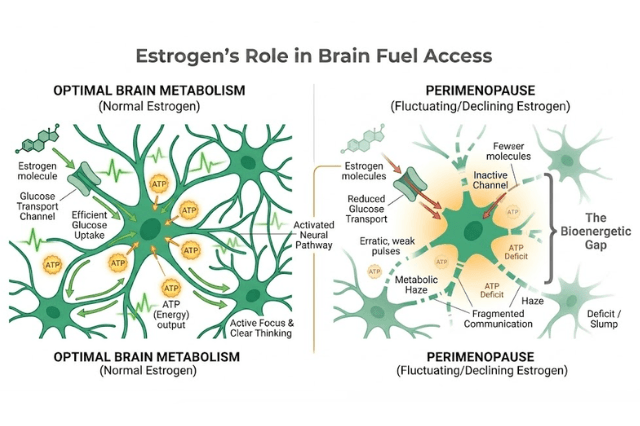
This energy shift is something researchers are actively studying. It is a physical transition. Your brain is trying to learn how to run on a different fuel source, but the transition is messy.
Early research suggests that supporting the brain’s recovery and metabolic balance during this window can noticeably shift the experience of mental haze.
The ‘Cognitive Tax’: Why Estrogen Is Only Part of the Story
We are often told that Hormone Replacement Therapy (HRT) is the only answer.
HRT can be a valuable tool for many women. However, it does not always clear the fog entirely.
This is because the transition period often leaves behind a metabolic haze. Your neural connections are operating with reduced availability of the neurotransmitters they need to stay sharp.
Acetylcholine levels, in particular, may become less stable during this time. Since acetylcholine is what enables your focus and working memory, its decline makes every task feel twice as difficult.
Many describe the subjective experience as operating on a three-second delay. You are still there. But your processor is struggling to keep up with the demand.

The ‘Survival Guide’: Managing the Haze Today
You do not have to wait for your hormones to level out to start feeling like yourself again.
● The Glucose Stabilizer: Avoid the mid-morning sugar crash. When your brain is already struggling to use glucose, a blood sugar spike followed by a drop makes the fog much thicker.
● The Choline Support: Provide your brain with the raw materials for acetylcholine. This helps maintain signal strength even when estrogen is low.
● The Strategic Disengagement: Give your prefrontal cortex a reset. Five minutes of quiet, eyes-closed rest can help lower the cognitive tax of the afternoon.
● The Circulation Pivot: Supporting healthy cerebral blood flow ensures that whatever glucose is available actually reaches your neurons.
Many describe the subjective experience of these changes as finally turning the lights back on. The static clears. The words come back.
The ‘Neural Resilience Protocol’: Bridging the Energy Gap
The most successful women I know in their 50s and 60s move beyond just waiting it out. They focus on resourcing the transition.
The Neural Resilience Protocol addresses the specific biological shifts that define the perimenopause brain.
Alpha GPC and Huperzine A are associated with supporting healthy acetylcholine levels. Many describe this as a feeling of mental grip that estrogen fluctuations used to steal away.
Ginkgo Biloba may support healthy cerebral circulation. This is vital when the brain’s energy metabolism is undergoing a major shift.
Lion’s Mane and Bacopa Monnieri are associated with the health and maintenance of neural connections. Users report that within a few weeks of consistent use, the glitch moments become noticeably less frequent.
Phosphatidylserine supports the fluidity of neural membranes. This allows signals to move cleanly even during hormonal dips. It makes thinking feel less like pushing through a physical barrier.
L-Theanine supports a state of calm focus. It is particularly helpful for the cognitive anxiety that often accompanies perimenopause brain fog.
The FAQ Reality Check: Addressing the Perimenopause Myth
Q: Is this the start of permanent memory loss? No. This is a transition phase. Your brain is highly adaptable. Resourcing it properly during this time helps support the function you are actually capable of.
Q: Why don’t doctors talk about the energy gap? Many medical approaches focus primarily on reproductive health. They often overlook the bioenergetic impact of hormones on the brain. This is a gap that researchers are only recently beginning to bridge.
Q: Can I fix this with diet alone? A healthy diet is the foundation. However, many describe the deepest shifts occurring when they add targeted nutritional support to bridge the specific gaps that whole foods often cannot fill in the required concentrations.
Customized High-Stakes Conclusion
Imagine your day without the fear of forgetting a name or losing your train of thought in a meeting.
Imagine having the same mental energy in the evening that you had before this transition began.
Perimenopause brain fog is not a character flaw. It is a biological signal that your brain is operating with reduced availability of one of the key mechanisms involved in how your brain accesses fuel.
When you bridge that energy gap, the fog stops being your new normal. You stop surviving the transition and start leading through it.