
What If the Fog Isn’t a Focus Problem?
You’ve tried the usual fixes.
More sleep. Less caffeine. Morning walks. A better planner. And some of it helped, at least for a while. But the fog keeps coming back. The word that should be there isn’t. The afternoon slump arrives right on schedule. The mental sharpness you remember from five years ago feels like it belongs to a different version of you.
Here’s a question most people never think to ask: what if the problem isn’t behavioral at all?
What if your brain is simply missing specific compounds it needs to function clearly, and no amount of productivity optimization can compensate for a biological deficit?
This perspective is gaining attention in cognitive nutrition research. It’s where the most interesting research in cognitive nutrition is pointing. And the answer involves compounds most Americans have never encountered, ingredients that don’t come in food in the amounts your brain actually needs, and a mechanism that explains why so many high-effort approaches to mental clarity produce only partial results.
The Science Deep-Dive: What Your Brain Actually Runs On
Look, here’s the deal: your brain is not a vague, mysterious organ that responds to motivation and willpower. It’s a precision biological machine that runs on specific inputs.
When those inputs are present in sufficient concentrations, the machine runs cleanly. Thoughts connect. Recall is fast. Focus holds without effort.
When the inputs are low, the machine slows. Not dramatically. Not in a way that shows up on a blood test or a doctor’s radar. Just enough to produce the exact experience most adults over 40 describe as brain fog and reduced mental clarity.
Here’s what the brain specifically needs, beyond the basics, that most diets simply don’t reliably deliver:
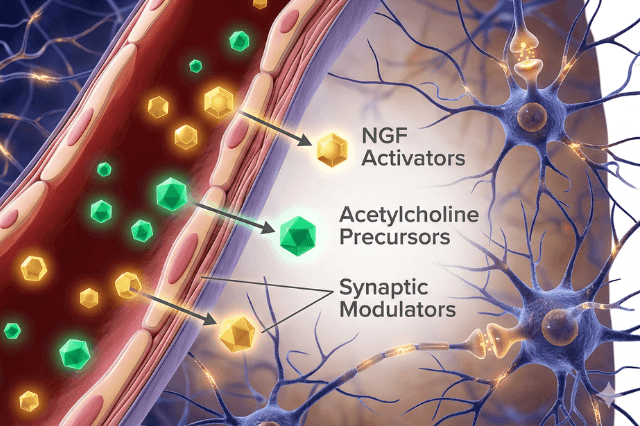
● Nerve Growth Factor support, to maintain the health and responsiveness of neural connections
● Acetylcholine precursors, to keep the neurotransmitter most linked to memory and learning at functional levels
● Cerebral circulation support, to ensure active neural areas are receiving adequate oxygen and nutrients
● Phospholipid support, for the membrane fluidity that allows neurotransmitters to move efficiently between cells
● Adaptogenic compounds, to buffer the cognitive impact of chronic stress without sedation
Most American diets, even genuinely healthy ones, tend to fall short on several of these. Not because people are eating badly. Because the concentrations required for cognitive benefit simply aren’t achievable through food in practical quantities.
The 5 Compounds Most Adults Are Running Low On
This is the part most doctors don’t have time to cover in a standard appointment. These aren’t exotic pharmaceuticals. They’re naturally occurring compounds with decades of research behind them. And they’re almost certainly not in your diet in the amounts your brain needs.
1. Lion’s Mane Mushroom (The NGF Activator)
Lion’s Mane contains compounds called hericenones and erinacines that early research suggests may support the production of Nerve Growth Factor, a protein associated with the maintenance and health of neural connections.
NGF production naturally changes as we age. Early research suggests that supporting it through targeted nutrition may be associated with improvements in cognitive fluency and mental clarity over time.
The catch? To approach the concentrations studied for cognitive benefit, you’d need to consume impractically large amounts of fresh Lion’s Mane daily. Not practical. Not palatable. That’s the bioavailability gap.
2. Bacopa Monnieri (The Memory Consolidation Herb)
Bacopa has centuries of traditional use and is now studied for its potential to promote memory retention and reduce the cognitive impact of chronic stress.
The mechanism is gradual. Bacopa works by supporting the efficiency of synaptic communication in areas associated with learning and memory. Most users report noticing meaningful shifts within a few weeks of consistent use, specifically in the reliability of recall under pressure.
Again, the therapeutic concentrations require extraction and standardization that food-based consumption can’t deliver.
3. Huperzine A (The Acetylcholine Protector)
Acetylcholine is the neurotransmitter most directly tied to memory formation, attention and cognitive clarity. Huperzine A, derived from Chinese club moss, is associated with maintaining healthy acetylcholine levels by inhibiting the enzyme that breaks it down.
Early research suggests it may support the kind of sustained working memory that makes conversations feel less effortful and information more retainable.
4. Phosphatidylserine (The Membrane Compound Nobody Talks About)
Phosphatidylserine is a phospholipid that forms part of the structure of cell membranes in the brain. It may support the fluidity of those membranes, which directly affects how efficiently neurotransmitters move between neurons.
When phosphatidylserine levels are well-supported, signal transmission may be cleaner and faster. Many describe the subjective experience as thoughts feeling more accessible, less like reaching through static.
5. Ginkgo Biloba (The Circulation Optimizer)
Ginkgo is one of the most studied botanical compounds for brain support. The research focuses on its potential role in promoting healthy cerebral circulation, which affects how well oxygen and nutrients reach active neural areas.
When circulation is well-supported, the cognitive cost of demanding mental work is lower. The afternoon degradation that most adults experience is partly a circulation issue, and Ginkgo may help address that specifically.
The Bioavailability Problem Nobody Tells You About
Here’s the core issue most nutritional conversations skip entirely.
Knowing which compounds support cognitive function is only half the problem. The other half is delivery.
Your brain sits behind the blood-brain barrier, a highly selective filtration system that blocks most substances from entering. Getting nutrients into the brain in therapeutically relevant concentrations requires:
● The right compounds (most don’t cross the blood-brain barrier effectively)
● The right extraction method (raw ingredients often lack the standardized active compound concentration needed)
● The right dosage (far beyond what whole foods can deliver)
● The right format (bioavailability varies dramatically between forms of the same compound)
This is why many people take generic multivitamins, eat reasonably well and still experience persistent brain fog. The inputs aren’t wrong. The delivery isn’t sufficient.
A specialized extraction and formulation process concentrates each compound into a bioavailable form your body can absorb and your brain can actually use. That’s the gap that targeted supplementation fills. Not because food is bad. Because precision that food can’t provide is required.
To complete this formulation, Alpha GPC (associated with mental drive and prefrontal cortex function) and L-Theanine (associated with calm focus and the reduction of cognitive anxiety) are included alongside the other compounds, forming the 7-Ingredient Cognitive Shield. A daily protocol that addresses the five specific nutritional gaps most likely behind the mental fog that behavioral changes alone haven’t been able to resolve.
Users report that the shift they notice first isn’t dramatic. It’s subtle. A reduction in the effort required to think clearly. A steadiness to the afternoon that wasn’t there before. Within a few weeks of consistent use, many describe the experience as their brain simply running closer to the level they remember.

Why Your Diet Alone Isn’t Enough: The FAQ Reality Check
Q: Can’t I just eat more brain-healthy foods?
Yes, and you should. Foods like walnuts, blueberries, fatty fish and dark leafy greens genuinely support cognitive health. But here’s the honest answer: the concentrations of Lion’s Mane hericenones, standardized Bacopa bacosides, Huperzine A and phosphatidylserine required for the cognitive benefits documented in research are simply not achievable through dietary intake alone.
You’d need to eat pounds of specific mushrooms, consume standardized herbal extracts in doses that don’t exist in food form, and source compounds like Huperzine A from plants that aren’t part of any typical diet. Eating well is the foundation. Targeted nutrition closes the gap.
Q: Are these nutrients safe?
The compounds in the 7-Ingredient Cognitive Shield have well-established safety profiles with decades of research and use. That said, individual responses vary, and some compounds (particularly Huperzine A and Bacopa) may interact with certain medications. As with any supplement, consulting your healthcare provider before starting is the right move, especially if you’re taking prescription medications.
Q: How long before I notice a difference?
This varies. Some users report noticing shifts in mental clarity and focus within the first week or two. The compounds with the deepest cognitive effects, particularly Bacopa Monnieri, are known to build gradually over three to four weeks of consistent use. The honest answer is that meaningful results are associated with consistent daily use over a sustained period, not a single dose.
Q: Do I need to take it forever?
No. Many users use it for a period of focused cognitive support, particularly during high-demand professional periods or transitions. Others incorporate it as an ongoing part of their cognitive maintenance routine. The 60-day satisfaction guarantee makes it low-risk to find out which category you fall into.
The Real Question Worth Asking
Most people spend years assuming their mental fog is a motivation problem, a sleep problem, or an inevitable aging problem.
The research increasingly suggests it may be none of those things.
It may simply be a nutritional gap. A specific deficit in compounds the brain needs to function at the level it’s actually capable of. Compounds that aren’t in your diet in the concentrations required. Compounds that a targeted daily protocol is designed to provide in consistent amounts.
That reframe changes everything. Because nutritional gaps are addressable. Deficits respond to inputs. And a brain that has what it needs performs differently than one that doesn’t.
If the fog has been persistent despite behavioral optimization, the missing variable may not be effort. It may be nutrition.
The 60-day satisfaction guarantee means you can find out without financial risk.