
I Thought I Was Losing My Mind. I Wasn’t.
I want to tell you something I didn’t say out loud for almost two years.
I started forgetting things. Not dramatically. Not in a way that would have alarmed a doctor. Just quietly, persistently, enough to notice. Names I should have known. Words that used to come easily. Details from conversations I’d had the day before.
I told myself it was stress. I told myself it was the pace of life. I told myself, more than once, that this was just what getting older felt like. And I kept going. Because what else do you do?
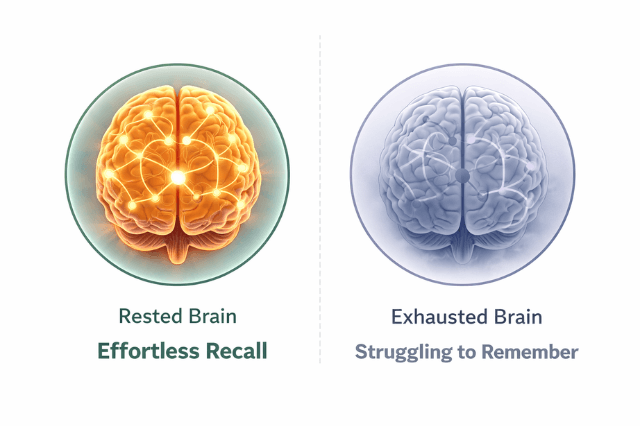
But here’s what I eventually figured out: I wasn’t becoming forgetful. My brain was exhausted. And those are two completely different things.
One is a capacity problem. The other is a resource problem.
And the moment I understood the difference, everything changed.
The ‘Cognitive Depletion Trap’: Why Exhaustion Mimics Forgetfulness
Look, here’s the deal: true forgetfulness and brain exhaustion feel almost identical from the inside. But they have different causes. And they respond to completely different solutions.
True forgetfulness, the kind worth worrying about clinically, involves structural changes to the brain’s memory systems. It’s progressive. It affects multiple domains simultaneously. It doesn’t improve with rest.
Brain exhaustion is different. It’s a state. A reversible, resource-driven condition that makes your memory, focus and recall perform far below their actual capacity. It feels like forgetfulness. It mimics forgetfulness. But the underlying architecture is intact. The hardware is fine. The system is just running on empty.
Here’s what’s depleting it.
The Metabolic Buildup Behind the Forgetting
Every cognitive process your brain runs generates metabolic byproducts. Memory retrieval. Decision-making. Sustained attention. All of it produces cellular waste that needs to be cleared.
Your brain has a natural clearing system that is believed to be most active during deep sleep. When it works properly, you wake up with a cognitively refreshed system that’s ready to encode new information, retrieve existing memories accurately and hold multiple things in working memory simultaneously.
When it doesn’t work properly (because of fragmented sleep, stress or the kind of low-grade chronic fatigue that’s become normal for most adults over 40), the buildup accumulates. And here’s how that accumulation shows up:
● Words that were accessible yesterday aren’t accessible today
● Names you know well take three seconds longer than they should
● You walk away from conversations retaining less than you used to ● Short-term memories don’t convert to long-term storage as reliably
● The mental effort required to retrieve information feels higher than it used to
That’s not a memory problem. That’s an exhaustion problem. And it has a very specific, very addressable cause.
The Energy Gap That Slows Retrieval
Here’s a distinction that almost nobody makes.
Memory retrieval is not passive. It’s an active, energy-intensive process. Your brain has to locate the stored pattern, activate the neural pathway connecting it, and bring the information forward into working memory. That takes ATP, which is real cellular fuel.
When mitochondrial efficiency is reduced (as it naturally does for many people over 40), retrieval takes more time, requires more effort and occasionally fails entirely. Not because the memory isn’t there. Because the energy required to access it may not be produced reliably enough.
Now, this part is wild. That retrievable-but-inaccessible experience is what most people interpret as forgetfulness. The name is in there. The word is in there. The detail from the conversation is in there. It just won’t load.
That’s exhaustion. Not erosion.
The Chronic Load That Prevents Recovery
The kicker? The modern lifestyle prevents the kind of genuine cognitive recovery that would allow the exhausted brain to reset.
● Fragmented sleep (the brain’s natural clearing system doesn’t fully complete its cycle)
● Continuous digital stimulation (no true cognitive downtime, even during rest)
● Chronic low-grade stress (sustained cortisol interferes with memory consolidation)
● Poor metabolic nutrition (the brain’s energy production is nutrient-dependent)
Each of these is individually manageable. Together, they create a compounding cycle of depletion that makes the exhausted brain look, from the inside, exactly like a failing one.
The ‘Neural Resilience Protocol’: What Actually Helps an Exhausted Brain
Anyway, here’s what I eventually found my way to, and what the research in cognitive performance points toward.
The exhausted brain doesn’t need stimulation. It needs the specific inputs that support its natural restoration processes. Inputs that may support the brain’s natural clearing processes, promote healthy neural energy production and maintain the signal clarity that memory retrieval depends on.
That’s what the Neural Resilience Protocol addresses. A targeted combination of seven neuro-nutrients studied for their potential to support the specific biological processes that distinguish a rested, clear-running brain from an exhausted, fog-running one.
Supporting Memory Retrieval
Lion’s Mane Mushroom may support Nerve Growth Factor production, a protein associated with the health and responsiveness of the neural connections memory retrieval depends on. What consistently shows up in user feedback is a gradual improvement in the ease of recall. Not a sudden clarity. A slow, steady reduction in the effort required to access information that’s already there.
Bacopa Monnieri is studied for its potential to promote memory retention and support cognitive function under chronic stress. This is particularly relevant for the exhausted brain, where stress-driven cortisol is actively interfering with memory consolidation. Within a few weeks of consistent use, users often report an improvement in how reliably short-term information converts to retrievable memory.
Huperzine A is associated with maintaining healthy acetylcholine levels, the neurotransmitter most directly tied to memory encoding and retrieval. When acetylcholine signaling is well-supported, the process of accessing stored information becomes more efficient. Early research suggests it may help address the “retrievable but inaccessible” experience that exhausted brains produce.
Supporting Cellular Energy and Clearance
Alpha GPC is associated with mental drive and sustained prefrontal cortex engagement. The kind of steady cognitive fuel that keeps retrieval running smoothly through a full day rather than degrading into increasingly effortful access by afternoon.
Ginkgo Biloba may support healthy cerebral circulation, which directly affects how efficiently oxygen and nutrients reach active memory-retrieval pathways. When circulation is well-supported, the energy cost of accessing stored information is lower. Many describe a reduction in that heavy, retrieving-through-mud experience over time.
Phosphatidylserine may support neural fluidity, the ease with which neurotransmitters move across cell membranes. For memory retrieval specifically, this matters because it affects the speed and reliability of the signal chain from storage to working memory. Think of it as reducing the static between the file and the screen.
L-Theanine rounds out the protocol with calm focus. Not stimulation. A state of relaxed alertness that prevents the anxiety-driven cognitive interference that makes retrieval even harder for already-exhausted brains. A common pattern is simply that the effort to recall something feels less fraught. Less tense. More like reaching and finding.
Together, these seven compounds form the 7-Ingredient Cognitive Shield. Early research suggests consistent use may support the brain’s natural maintenance and recovery processes over time, and may support healthier neural signal transmission throughout the day.
If the forgetting you’ve been experiencing feels more like exhaustion than erasure, you’re probably right about that. In recent user feedback, many users report noticing meaningful improvements in recall ease and cognitive availability within a few weeks of consistent use. Many described it as the first time in years that remembering something felt effortless rather than effortful.

The ‘Memory Recovery Morning’: A Routine Built for the Exhausted Brain
The exhausted brain doesn’t need more demands placed on it before it’s had a chance to recover. It needs the morning to work for it rather than against it.
Step 1: Water before everything. Sixteen ounces before your phone, before coffee, before any cognitive engagement. Your brain is made up largely of water. After eight hours without fluid, mild dehydration (1-2%) can impact memory retrieval speed and working memory capacity. This is the lowest-effort, highest-return morning input available. Most people skip it.
Step 2: The neural nutrition window. One dropper of the Neurodyne formula under the tongue, held for 30 seconds, followed by a second dropper in water. Under three minutes. Done before the day makes its first demand. All seven compounds delivered in bioavailable concentrations before the cognitive load begins. This isn’t about adding to the morning. It’s about resourcing the brain before the depletion cycle starts.
Step 3: The strategic afternoon reset. Ten minutes of complete cognitive rest before 2 PM. No screen, no audio, no input. The brain’s natural clearance system needs downtime to function. This brief window allows the metabolic waste from the morning’s work to begin clearing, reducing the afternoon retrieval degradation that most exhausted brains experience predictably.
Over time, the combination of these three steps starts shifting the quality of afternoon memory access within a few weeks of consistency. The “it was on the tip of my tongue” experience becomes less frequent. The cognitive friction of remembering reduces. The brain starts to feel less like something you’re fighting and more like something that’s working with you.
What It Feels Like When the Exhaustion Lifts
Here’s what I can tell you from the other side of it.
The forgetting doesn’t stop entirely. Nobody’s memory is perfect. But the quality of the forgetting changes. It stops feeling like loss and starts feeling like normal cognitive variation. The name that took twenty seconds now takes three. The word that disappeared mid-sentence now arrives a beat late rather than not at all.
The more meaningful shift is in the texture of daily memory access. Conversations feel more retainable. Details from yesterday feel present rather than hazy. The effort of remembering reduces to a level where it stops being something you notice at all.
At work, it means fewer “sorry, could you repeat that?” moments. Fewer emails reread to catch what was missed. Fewer end-of-day gaps in what got processed and what didn’t.
At home, it means being actually present in conversations rather than half-listening while the other half of your brain tries to keep track of everything you need to remember. It means the small details, the ones that make people feel heard and remembered, actually stick.
That’s what users describe when the exhausted brain starts receiving the resources it needs, and the 7-Ingredient Cognitive Shield is supporting the results it was designed for over time.
You’re not forgetful. You’re depleted. And depletion responds to the right inputs.
The 60-day satisfaction guarantee means you can find out exactly what your brain feels like when it’s no longer running on empty.