
“It’s Just Part of Getting Older.” You’ve Heard That Before.
You sat in that office and described what’s been happening.
The words that slip away. The afternoon fog that rolls in no matter how much sleep you got. The names you reach for and can’t find. The feeling, persistent and low-grade, that your brain is working against you instead of for you.
And the doctor nodded. Maybe ran a quick test. Maybe didn’t. And then said some version of the same thing you’ve been hearing for years.
“It’s normal for your age.”
“It happens to everyone.”
“There’s nothing to worry about.”
You drove home with more questions than answers. Because here’s the thing: it doesn’t feel normal. It feels like something changed. Something specific. And the explanation you were given doesn’t actually explain anything. It just closes the door.
Let’s be honest. “It’s just aging” is one of the most common explanations given — but it rarely tells the full story. It shuts down curiosity. It leaves you without real tools to navigate what you’re experiencing. And for a lot of people, it simply doesn’t account for what’s actually driving the fog.
Brain fog has causes. Real, specific, addressable causes. And most of them have nothing to do with the number of candles on your last birthday cake.
What’s Actually Happening Inside Your Brain
Look, here’s the deal: cognitive changes over 40 are real. Nobody is saying otherwise. But there is a massive difference between the natural, gradual shifts in processing speed that come with age and the kind of fog that derails your sentences, steals your train of thought and leaves you standing in your kitchen wondering why you came in.
One is a gentle slope. The other is a signal. And signals have sources.
Mental Haze Buildup
Here’s what rarely gets discussed in a 15-minute primary care appointment.
Your brain produces metabolic byproducts every single time it works. Every thought, every decision, every memory retrieval generates cellular waste. Under ideal conditions, your brain clears this buildup automatically, through a dedicated cleansing system that activates primarily during deep sleep.
The problem? Most Americans over 40 are not getting the kind of deep, uninterrupted sleep that system requires to function properly. So the metabolic haze accumulates. Day after day, week after week, it settles into the spaces between your neural pathways like sediment. The signals that used to travel cleanly start to drag. The words that used to arrive instantly start to lag.
Users report experiencing this as a kind of cognitive static. Not absence of thought. More like poor reception. The idea is there. It’s just not coming through clearly.
And when you describe that to a doctor in a short appointment, the easiest response is “that sounds like normal aging.” It’s not always wrong. But it’s almost never the whole story.
The Cellular Energy Gap
Think about what your brain actually runs on.
ATP. The energy currency your mitochondria produce. Your brain consumes roughly 20% of everything you eat despite being only 2% of your body weight. It is the single most energy-hungry organ in the human body. And it needs a consistent, reliable supply of fuel to perform even basic cognitive functions well.
Now, this part is wild. Mitochondrial efficiency naturally shifts over time. The cellular energy production that felt effortless in your 30s may be running at reduced capacity in your late 40s or 50s. Not dramatically. Not in a way that shows up on a standard blood panel. But enough to affect how your brain handles a full day of cognitive demand.
The afternoon slump. The sentence that trails off. The thought that was right there and then wasn’t. These may not be signs of inevitable decline. They may be signs of a cellular energy gap that has specific, addressable causes.
Modern Decision Fatigue
The kicker? The modern American lifestyle piles an extraordinary amount of cognitive load onto brains that are already running lean on resources.
Before you’ve finished your first cup of coffee, you’ve processed dozens of notifications, made micro-decisions about what deserves your attention and already begun depleting the finite cognitive reserve that has to last you all day. By 2 PM, you’re not just tired. You’re neurologically depleted.
And when you describe that exhaustion to a doctor, the most convenient explanation is age. But the more accurate explanation might be load. Your brain is carrying more than it’s been given the resources to carry.
The ‘Neural Resilience Protocol’: What the Appointment Didn’t Cover
Anyway, here’s where the real conversation begins.
A growing field of research in cognitive performance and nutritional neuroscience is focused on something most primary care appointments don’t have time to address: what you can do proactively to support the specific biological processes that keep your brain running clearly. Not after a diagnosis. Not in response to a crisis. Right now, while your brain is still fully capable of responding to the right inputs.
The Neural Resilience Protocol is the term researchers and high-performance practitioners use for a specific combination of neuro-nutrients that may support the brain’s natural clearing mechanisms, promote healthy neural communication and help maintain the cellular energy output that clear thinking requires.
Supporting Healthy Neural Pathways
Lion’s Mane Mushroom is the most studied functional mushroom for cognitive support. Early research suggests it may support Nerve Growth Factor production, a protein associated with the health and maintenance of neural connections. Users report noticing a gradual improvement in mental fluency and word recall over the first few weeks of consistent use. Not a sudden shift. A quiet, progressive clearing.
Bacopa Monnieri has a long history of traditional use and is now studied for its potential to promote memory retention and support cognitive function under chronic stress. Many users describe noticing, within a few weeks of consistent use, that their thoughts feel more accessible and stable mid-conversation. The specific experience of watching a thought slip just before speaking it becomes less frequent.
Huperzine A is associated with maintaining healthy acetylcholine levels, the neurotransmitter most directly involved in attention and working memory. Early research suggests it may support the kind of moment-to-moment cognitive reliability that makes conversations feel less effortful and thoughts feel less slippery.
Alpha GPC is associated with mental drive. The sustained prefrontal cortex engagement that keeps you on a cognitive thread through a complex task or a long meeting without losing the plot.
Natural Cognitive Clearing
Ginkgo Biloba is among the most extensively studied botanical compounds for brain support. Research focuses on its potential role in promoting healthy cerebral circulation, which may support the brain’s ability to deliver nutrients to active areas and naturally manage the metabolic buildup that accumulates during sustained cognitive work.
Phosphatidylserine may support neural fluidity, the ease with which neurotransmitters move between cells. When this process is well-supported, signals may travel more cleanly. Many describe the experience as thoughts arriving more fully formed, with less of the static that makes routine conversation feel like hard work.
The Bioavailability Factor
Here’s what most people don’t know.
Getting these compounds in the concentrations associated with cognitive benefit through food alone is essentially impossible. A specialized extraction and formulation process is required to concentrate each ingredient into a form your body can absorb and actually use consistently. That’s the gap a well-formulated supplement fills. Not magic. Just precision that diet can’t match.
L-Theanine, the seventh compound in this protocol, supports calm focus. A state of relaxed alertness that allows the rest of the stack to work without overstimulation. Users report the overall experience as sustainable clarity. Present, focused and steady rather than artificially wired.
Together, these seven compounds form the 7-Ingredient Cognitive Shield. Early research suggests this targeted nutritional support may optimize the brain’s Deep-Cycle Cognitive Refresh process over time, promoting natural management of metabolic haze and supporting healthier neural communication throughout the day.
When your doctor says brain fog is normal for your age, they may be describing a trend without addressing its causes. In recent user feedback, a majority reported noticing meaningful shifts in cognitive clarity within a few weeks of consistent use. For many, the experience was less about dramatic change and more about a gradual return to feeling like themselves again.

The 5-Minute Morning Routine That Supports What Your Appointment Didn’t
You don’t need a new prescription. You need a consistent daily input.
Hydration first. Sixteen ounces of water before your phone, before coffee, before anything else. Your brain is roughly 75% water. Even mild dehydration (1-2%) measurably affects working memory and processing speed. This is the simplest cognitive support available. It costs nothing and takes thirty seconds. Most people skip it every day.
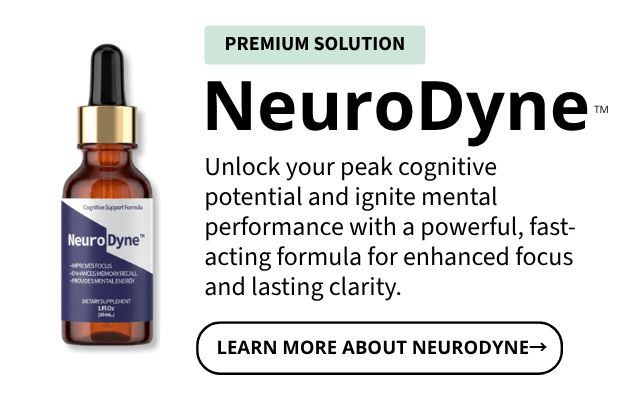
Targeted nutrients. One dropper of the Neurodyne formula under the tongue. Hold for 30 seconds. Swallow. A second dropper in water. Under five minutes, integrated into a routine you already have. All seven compounds in precise, bioavailable concentrations your brain can actually use from the first dose.
One real break before 2 PM. Ten minutes completely away from screens. No audio, no scrolling. Walk outside or sit quietly. This is when your brain consolidates active working memory and manages the cognitive buildup from the morning. The people who report the clearest thinking in the second half of the day almost always take this break deliberately.
The narrative that brain fog is inevitable is convenient. But it isn’t always accurate. And it isn’t useful. Many users report that once a consistent daily routine is established, the experience of navigating a full day of cognitive demand feels meaningfully different within a few weeks.
What It Looks Like When You Stop Accepting the Explanation
Here’s what users report over time with the protocol.
The static clears. Not all at once. Gradually. The words that used to trail off start arriving on time. The names that used to take three seconds come back in one. The afternoon fog that used to settle in around 2 PM starts to lift. Or not arrive at all.
At work, they’re tracking more. Following complex threads through long meetings. Responding accurately without having to ask people to repeat themselves. Not because they’re working harder. Because the friction has reduced.
At home, they’re present. Not physically in the room while mentally somewhere else. Actually engaged. Actually available. Actually themselves in the way they remember being before all of this started.
That’s what users describe when the metabolic haze is being managed daily and the 7-Ingredient Cognitive Shield is supporting the results it was designed for over time.
“It’s just aging” is a sentence. It’s not a sentence you have to accept. The fog has causes. Causes have solutions. And a 60-day satisfaction guarantee means you navigate the first two months of the protocol with no financial risk.