
The Thought That Was Just There: And Then It Wasn’t
It happens in the middle of a sentence.
You’re talking. Could be a work call, could be dinner with your family. The thought is fully formed. You know exactly where you’re going with it. And then, somewhere between your brain and your mouth, it just slips away.
You pause. You say “sorry, I lost my train of thought.” You laugh a little. The other person says “no worries, happens to me too.” And the conversation moves on.
But you noticed. And it’s been happening more.
Not just mid-sentence. Mid-task too. You’re writing something and you look up for one second, then look back and can’t find the next word you were about to type. You’re reading and you reach the bottom of the page and realize you absorbed nothing. You have to start again.
You’re not zoning out because you’re bored. You’re zoning out because something is interfering with the signal.
Think about it. A year ago, this happened occasionally. Now it’s daily. And the really unsettling part isn’t the forgetting itself. It’s the feeling of watching it happen. The strange awareness that your thoughts are becoming less stable. Less yours.
Your brain isn’t giving up on you. But something is quietly working against it. One thought at a time.
The ‘Brain Tax’ You’re Paying Without Knowing It
Look, here’s the deal: the fog you’re experiencing isn’t random. It has a cause. Several, actually. And none of them are “just aging.”
Most people over 40 are running their brains under conditions that would make any high-performance system struggle. Chronic low-grade sleep deprivation. Relentless digital stimulation. Decision overload from the moment the alarm goes off. Zero real downtime for the brain to do what it naturally needs to do.
The result is a kind of cognitive erosion. Slow, subtle and easy to rationalize away. Until it isn’t.
Mental Haze Buildup
Here’s something most people have never been told.
Your brain generates metabolic waste every single time it works. Every thought, every memory access, every burst of focus produces cellular byproducts that need to be cleared. Your brain has a dedicated system for this, a cleansing cycle that activates primarily during deep sleep.
The problem is that system only runs properly when you get enough deep, restorative sleep. And most Americans over 40 aren’t getting it consistently.
So the buildup accumulates. Day after day, it settles around your neural pathways like a slow-moving fog that never fully lifts. The signals your brain sends get muddier. The connections that used to feel instant start to feel effortful. The thoughts that used to flow start to slip.
Users report noticing it first in conversations, that fraction-of-a-second delay before a word arrives that didn’t used to be there. Then in reading. Then in the middle of their own sentences.
It’s not dramatic. That’s what makes it easy to ignore until it isn’t anymore.
The Cellular Energy Gap
Your brain is an energy machine. It runs on ATP, the fuel your mitochondria produce, and it demands roughly 20% of your total caloric output despite being only 2% of your body weight.
Now, this part is wild. Mitochondrial efficiency naturally shifts over time. The cellular “power plants” inside your neurons may produce less ATP per cycle than they once did. Which means your brain is running a more demanding workload on a tighter energy budget than it was ten years ago.
The fog you feel isn’t imaginary. It’s your brain operating under an energy constraint. Not because it’s broken. Because the supply isn’t consistently meeting the demand.
Modern Decision Fatigue
The kicker? The modern information environment has made this dramatically worse.
Your brain processes thousands of inputs before noon. Notifications, emails, news, choices, conversations, context switches. Each one draws from the same finite cognitive reserve. And by afternoon, you’re not just physically tired. You’re neurologically depleted.
The thoughts that slip mid-sentence aren’t gone because your brain is failing. They’re slipping because your brain is making resource decisions under pressure. And something had to give.
The ‘Neural Resilience Protocol’: What High-Performers Are Using Instead
Anyway, here’s where things shift.
The conversation in cognitive performance research has moved well beyond “get more sleep and reduce stress.” Researchers working with high-performing adults are increasingly focused on targeted nutritional support. Specific neuro-nutrients that may support the brain’s natural clearing mechanisms, promote healthy neural communication and provide the raw materials mitochondria need to produce energy more consistently.
This is the Neural Resilience Protocol. Not a drug. Not a stimulant. A precise combination of seven compounds that work with your brain’s existing biology to support the conditions under which it performs best.
Supporting Healthy Neural Pathways
Lion’s Mane Mushroom is the most researched functional mushroom for cognitive support. Early research suggests it may support Nerve Growth Factor production, a protein associated with the health of neural connections. Users report that mental clarity gradually improves over the first few weeks of consistent use. Not a sudden surge. A quiet, steady settling of the cognitive noise.
Bacopa Monnieri has been used for centuries and is now studied for its potential to promote memory retention and reduce the cognitive drag of chronic stress. Most users report noticing a shift within a few weeks of consistent use. Specifically in how reliably their thoughts stay accessible mid-conversation and mid-task.
Huperzine A is associated with maintaining healthy acetylcholine levels, the neurotransmitter most directly tied to attention and working memory. Early research suggests it may support the kind of moment-to-moment cognitive continuity that keeps thoughts stable between one sentence and the next.
Alpha GPC is associated with mental drive and sustained prefrontal cortex function. The ability to stay on a single cognitive thread without it unraveling every time something pulls your attention sideways.
Natural Cognitive Clearing
Ginkgo Biloba is one of the most extensively studied compounds for brain support. Research focuses on its potential role in promoting healthy cerebral circulation, which may support the brain’s ability to deliver oxygen and nutrients to active neural areas and naturally manage the metabolic haze that accumulates during sustained mental work.
Phosphatidylserine may support neural fluidity, the smooth movement of neurotransmitters across cell membranes. When this process is well-supported, signals may travel more cleanly. Many describe the experience as thoughts arriving more fully formed and feeling more stable throughout the day.
The Bioavailability Factor
Here’s something most people never consider.
You cannot get these compounds in meaningful amounts through food. Even an excellent diet falls dramatically short of the concentrations associated with cognitive benefit in research. A specialized extraction process is required to concentrate each ingredient into a bioavailable form your body can absorb and actually use.
L-Theanine, the seventh compound in this protocol, supports calm focus. A state of relaxed alertness that allows the rest of the stack to work smoothly, without the jitteriness or overstimulation that comes from caffeine-based approaches. Users report the overall effect as a quiet, sustainable clarity. Nothing forced. Nothing artificial.
Together, these seven compounds form the 7-Ingredient Cognitive Shield. A daily routine that early research suggests may support the Deep-Cycle Cognitive Refresh process, promoting the natural management of metabolic haze and healthier neural communication over time.
If your thoughts have been less stable than they used to be, your brain may be running low on the specific nutrients it needs to keep those signals clean and consistent. In recent user feedback, a majority reported noticing shifts in cognitive clarity within a few weeks of consistent use. For many, the first noticeable change was simply that their thoughts felt more reliable mid-conversation.

The 5-Minute Morning Routine That Keeps the Signal Clear
The most effective cognitive support routines are the ones that require almost no effort to maintain. Because effort is exactly what you’re trying to preserve.
Hydration first. Sixteen ounces of water before your phone, before coffee, before anything. Your brain is roughly 75% water. Mild dehydration (as little as 1-2%) measurably degrades working memory and attention. This takes thirty seconds and costs nothing. Most people skip it every morning.
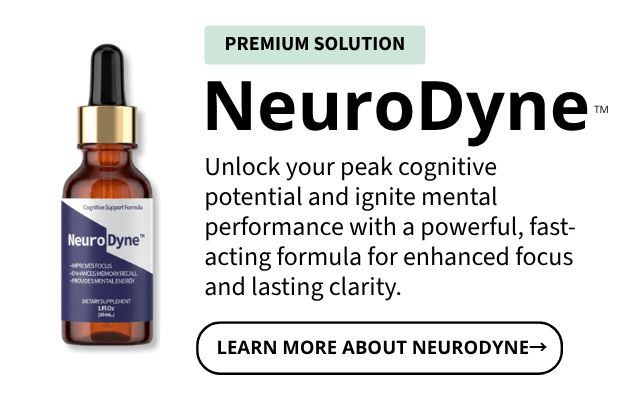
Targeted nutrients. One dropper of the Neurodyne formula under the tongue. Hold for 30 seconds. Swallow. A second dropper in water. Done. Under five minutes, folded into a routine you already have. All seven compounds delivered in bioavailable concentrations your brain can actually use.
One real break before 2 PM. Ten uninterrupted minutes away from every screen. No audio, no scrolling. Just sitting or walking quietly. This is when your brain processes and consolidates what it’s been holding. The people who report the clearest, most reliable thinking in the afternoon are almost always the ones doing this consistently.
The trap most people fall into is treating cognitive support as something to add on top of an already overloaded schedule. The real shift happens when you treat it as infrastructure. Non-negotiable, simple and already built into your morning before the demands of the day begin. Many users report that once the daily routine is established, maintaining it requires almost no conscious effort at all.
What It Feels Like When the Fog Starts to Lift
Users over time start reporting something specific.
Thoughts feel more stable. Not mid-sentence slipping. Not mid-task losing the thread. The intention stays accessible long enough to act on it. They finish what they were saying. They read a page and retain it. They’re in a conversation and they’re actually in it, not performing presence while internally searching for what they were about to say.
At work, they’re tracking more. Responding more accurately. Not because they’re trying harder. Because the friction has reduced.
At home, they’re present differently. Not just physically in the room. Mentally available. Actually listening. Actually contributing.
That’s not a marketing promise. That’s what users describe when the metabolic haze is being managed daily, when neural communication is well-supported, when the 7-Ingredient Cognitive Shield is doing what it’s designed to do over time.
The fog isn’t permanent. The slipping thoughts aren’t inevitable. They’re signals. Clear signals that your brain is asking for something specific.
The 60-day satisfaction guarantee means you can navigate the first two months of the protocol without financial risk. The only real question is how many more foggy days you’re willing to accept before you decide to address it.