
You’re Not Distracted. You’re Being Drained.
Most people who struggle with mental clarity assume the problem is attention.
They try to focus harder. They download productivity apps. They make lists, block time, put their phone face-down. And it helps. A little. For a while.
Then the fog comes back.
Here’s the thing: if your mental clarity keeps slipping despite your best efforts, the problem isn’t discipline. It’s drain. Something, or rather several things, are pulling your cognitive resources out from under you before you even get a chance to use them.
And the frustrating part is that most of these things feel completely normal. They’re woven into ordinary American daily life so thoroughly that most people never think to question them.
This isn’t about what you’re failing to do. It’s about what’s happening to your brain without your permission.
The Myth-Buster: What “Mental Clarity” Actually Requires
Look, here’s the deal: mental clarity isn’t the absence of stress or the presence of motivation. It’s a physiological state. It requires specific biological conditions to exist.
Your brain needs:
● A consistently clear signal pathway between neurons
● Adequate cellular energy (ATP) to power cognitive processes
● A regularly completed overnight clearing cycle to flush metabolic waste
● Stable acetylcholine levels to support attention and working memory
● Sufficient cerebral blood flow to deliver oxygen to active areas
When all five of these are met, thinking feels effortless. Ideas connect. Words arrive. Focus holds.
When even two or three are compromised, the experience is exactly what most people describe as “brain fog.” Not dramatic. Not disabling. Just off.
And here are the five things most likely draining those conditions every single day.
1. Fragmented Sleep (The One Nobody Takes Seriously Enough)
You probably know sleep matters. You probably don’t know how specifically it matters for mental clarity.
Your brain has a natural clearing system that is believed to be most active during the deeper stages of sleep. This process manages the metabolic byproducts that accumulate during waking cognitive activity. Think of it as the overnight maintenance cycle that keeps the system running clean.
When sleep is fragmented, short or consistently shallow, that cycle doesn’t complete. The buildup accumulates. Day after day, week after week, it settles around your neural pathways and reduces the clarity of the signals your brain sends.
The result isn’t dramatic memory loss. It’s the subtler, more insidious experience of everything requiring slightly more effort than it should. Thoughts that take a beat longer. Words that arrive a half-second late. Conversations you follow but don’t fully retain.
Most people adapt to this as their new normal. It isn’t normal. It’s accumulated debt.
2. Digital Overload (The Drain You Can’t Feel)
Here’s what your brain is actually doing when you scroll.
Every notification, every switch between app to app, every piece of content your eyes land on triggers a small but real cognitive processing event. Your brain has to evaluate it, decide its relevance and either engage or dismiss it. That’s not passive. That takes resources.
Now, this part is wild. Research on attention and cognitive load consistently shows that the constant availability of digital stimulation doesn’t just fragment attention in the moment. It degrades the baseline capacity for sustained focus over time.
The people reporting the sharpest mental clarity in their 50s and 60s almost universally describe intentional, structured limits on digital consumption. Not elimination. Structure. Specific periods of genuine cognitive quiet built into every day.
Your brain can’t run maintenance while it’s constantly being interrupted. Every hour of unstructured digital exposure is an hour the system doesn’t get to reset.
3. Chronic Dehydration (The Subtlest Drain of All)
Your brain is made up largely of water. And mild dehydration, the kind you don’t feel as thirst, can measurably impact working memory, processing speed and attentional control.
The problem? Most Americans are mildly dehydrated for most of the day and have no idea. Coffee dehydrates. Dry office air dehydrates. Stress dehydrates. And by the time the signal gets strong enough to feel like thirst, cognitive performance has already been affected.
The fix is almost insultingly simple. Sixteen ounces of water before coffee every morning. Water alongside coffee rather than instead of it. A glass before every meeting.
It’s not glamorous. But it’s one of the highest-return cognitive interventions available, and it costs nothing.
4. Caffeine Cycling (The Clarity Illusion)
Caffeine doesn’t create mental clarity. It creates the temporary perception of it.
What caffeine actually does is block adenosine receptors, the receptors that signal fatigue. So while your brain still has the same accumulated metabolic buildup, the same depleted neural resources, the same incomplete overnight maintenance, you feel alert.
Until you don’t.
The crash that follows isn’t just tiredness. It’s the accumulated fatigue your brain has been carrying all day, finally breaking through. And the response most people have (another coffee) restarts the cycle and pushes the genuine recovery further away.
The kicker? Habitual high-caffeine consumption has been associated in some research with reduced baseline alertness over time. Meaning the more you rely on it, the less effective your brain becomes at producing its own natural clarity.
This isn’t an argument against coffee. It’s an argument against using coffee as a substitute for actual cognitive support.
5. Skipped Recovery Windows (The Thing That Multiplies Everything Else)
Your brain needs genuine downtime during the day to consolidate what it’s learned and clear the cognitive load from active working memory.
Most people never give it that.
The 10-minute gaps between tasks get filled with phones. Lunch gets eaten while answering emails. Commutes get consumed by podcasts. Every potential recovery window gets colonized by more input.
The result is a brain that carries the full cognitive load of the day without any mid-day relief. By 3 PM, the working memory is near capacity, signal clarity has degraded and the experience of “mental fog” is at its peak.
Two or three deliberate 10-minute windows of genuine cognitive rest, no screen, no audio, no input, can measurably extend the period of clear cognitive function across the second half of the day.
This is the single highest-leverage habit most people are missing. And it requires no equipment, no purchase and no skill.
The Connection Most People Miss
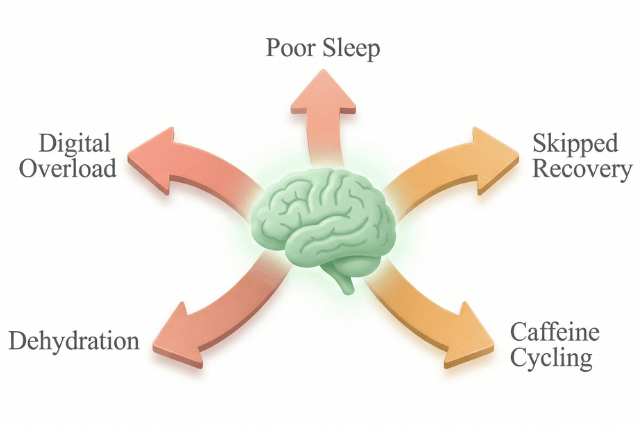
These five drains don’t operate independently. They compound each other.
Poor sleep makes you more dependent on caffeine. Caffeine makes sleep lighter. Digital overload depletes the cognitive resources that dehydration was already reducing. Skipped recovery prevents the system from ever catching up.
By the time most adults over 40 experience significant mental fog, they’re usually dealing with all five simultaneously. And the fog isn’t the disease. It’s the symptom. Of a system running on chronic deficit.
Addressing the behavioral components above, genuinely, consistently, makes a real difference. For many people, it’s the difference between functioning and thriving.
But here’s what the research is also showing: even when behavioral inputs are optimized, there’s often a nutritional gap that lifestyle alone can’t close.
Your brain’s ability to maintain clear signal transmission, support acetylcholine levels, promote healthy circulation and manage metabolic byproducts depends on specific compounds that most diets don’t reliably deliver in the concentrations needed. Some users report that addressing this gap with targeted nutritional support is what finally made the behavioral changes feel like they were actually working.

The ‘Neural Resilience Protocol’: Closing the Gap Behavioral Changes Can’t
Anyway, here’s what the performance nutrition research points toward for each of the five drains above.
For the sleep recovery gap: Lion’s Mane Mushroom may support Nerve Growth Factor production, associated with the maintenance of healthy neural connections. Early research suggests consistent use may support the brain’s natural maintenance processes, helping to address some of the accumulation that disrupted sleep leaves behind.
For the digital overload drain: Alpha GPC is associated with sustained prefrontal cortex function, the kind of steady cognitive engagement that makes it easier to maintain focus despite a high-stimulation environment. L-Theanine promotes calm focus, a state of relaxed alertness that may help buffer the attentional fragmentation that constant connectivity produces.
For dehydration-related cognitive decline: Phosphatidylserine may support neural fluidity, the efficiency of signal transmission between neurons. When hydration is suboptimal, this compound may help support signal clarity through the pathways that dehydration makes sluggish.
For the caffeine cycling trap: Bacopa Monnieri is studied for its potential to promote memory retention and support cognitive function under chronic stress. Unlike caffeine, it doesn’t block fatigue signals. It may support the underlying conditions that make genuine clarity possible, so the brain needs less artificial stimulation to perform.
For the skipped recovery deficit: Ginkgo Biloba may support healthy cerebral circulation, which matters most during the periods when the brain is trying to consolidate and clear. Huperzine A is associated with maintaining healthy acetylcholine levels, the neurotransmitter that supports the working memory consolidation that recovery windows are supposed to provide.
Together, these seven compounds form the 7-Ingredient Cognitive Shield. A targeted daily routine that early research suggests may support the brain’s own recovery and signal maintenance processes over time.
Users report that what shifts first is the experience of the mid-afternoon. The 3 PM fog becomes less predictable. Then less frequent. Then, for many, simply less severe. Within a few weeks of consistent use, many describe the daily drains feeling like they have less purchase on their day.
The 7-Day Mental Clarity Audit: Start Here
Before you change anything, spend one week tracking these five drains honestly.
Day 1-2: Note your sleep quality, not just hours. Did you wake up in the night? Did you feel rested?
Day 3-4: Count your actual digital input windows. How many genuine breaks did you take with no screen?
Day 5: Track your water intake before noon. How many ounces before your first coffee?
Day 6: Notice your caffeine pattern. How many cups? At what times? What does the crash feel like?
Day 7: Count your genuine recovery windows. Did you take any 10-minute breaks with zero input?
Most people who do this audit for the first time are surprised by how many of the five drains they’re experiencing simultaneously. Not because they’re careless. Because the modern American day is structured, almost by design, to produce exactly this outcome.
Knowing which drains are heaviest for you is the starting point. From there, you can address them specifically. And for the nutritional gap that behavioral change alone can’t close, targeted support exists that may make the difference between managing the fog and actually clearing it.
The 60-day satisfaction guarantee means you can run the full protocol alongside the audit with no financial risk. If it doesn’t support the results it was designed for over time, you get your money back.