
The Myth of the “Senior Moment”
We have been conditioned to accept the decline.
You forget a name at a dinner party. You misplace your glasses for the third time this morning. You struggle to find the right word during an important presentation.
The people around you laugh it off. They call it a senior moment. They tell you it is just a natural part of getting older.
But deep down, you feel a difference. There is a distinction between the slow, graceful transition of normal aging and the sudden, frustrating haze that seems to be clouding your daily life.
The truth is that aging does not have to mean losing your edge. High-level cognitive function is possible well into your 80s.
If you feel like your brain is operating behind a curtain of fog, you may not be experiencing typical aging alone. You may be dealing with a resource gap that is manageable once understood.
The Myth-Buster: Why Age Is Not Your Primary Enemy
Most people believe their brain is simply wearing out like an old car engine.
This is a biological misconception. While much of the underlying structure remains relatively intact over the decades, your neural networks are designed to remain plastic and adaptive.
Normal aging might mean it takes you a few extra seconds to recall a specific date. It might mean you learn a new software slightly slower than a 20-year-old.
However, normal aging does not typically cause a significant loss of focus or persistent mental fatigue. It does not usually cause the sudden “exhaustion” that shuts your brain down by mid-afternoon.
What is happening to many adults over 40 is not a structural failure. It is often a functional deficit in the prefrontal cortex.
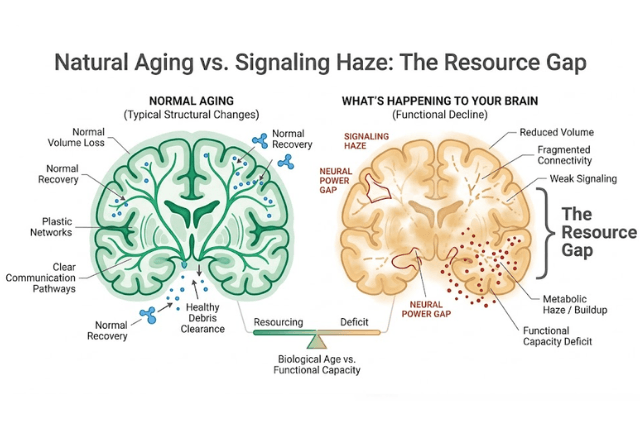
This signaling haze is something researchers are actively studying. It is often a signal that your brain may be running at a deficit of the neurotransmitters required for clear communication.
Early research suggests that supporting the brain’s recovery and metabolic balance can noticeably shift this experience.
The ‘Brain Tax’: The Hidden Accumulation
Think of your brain like a high-performance computer.
Over the years, the hardware remains functional. But your system may begin to accumulate more metabolic byproducts over time.
Under optimal conditions, your body is prioritizing healthy recovery processes. However, as we age, our ability to efficiently clear waste may become less efficient.
This creates what many describe as a metabolic haze. It can slow down the speed at which your neurons can fire and process information.

The ‘Survival Guide’: Distinguishing the Signs
You need to know what you are actually fighting.
● Normal Aging: You forget where you put your keys but find them later by retracing your steps.
● The Resource Gap: You place items in unusual locations and don’t recall doing it shortly after.
● Normal Aging: You occasionally struggle to find the exact word but remember it later.
● The Resource Gap: You lose the entire thread of a conversation because your brain may be struggling to hold working memory long enough.
● Normal Aging: You feel tired after a long, stressful day of complex problem-solving.
● The Resource Gap: You feel mentally exhausted by 2 PM regardless of how much restorative rest you had.
Many describe the subjective experience of moving from the gap back to normal function as finally clearing a dirty windshield. The world becomes sharp again.
The ‘Neural Resilience Protocol’: Resourcing the 50+ Brain
Many high-performers over 50 move beyond stimulants. They recognize that the goal is not to force the brain into working, but to resource it.
The Neural Resilience Protocol focuses on the specific compounds involved in how your brain accesses fuel and maintains signal clarity.
Alpha GPC and Huperzine A are associated with supporting healthy acetylcholine levels. Many report that this provides a sense of mental grip that they thought was less accessible as they aged.
Ginkgo Biloba may support healthy cerebral circulation. This ensures that the oxygen and glucose your prefrontal cortex demands actually arrive in real time.
Lion’s Mane and Bacopa Monnieri are associated with the health and maintenance of neural connections. Users report that the mental warm-up period of the day becomes noticeably shorter.
Phosphatidylserine supports the fluidity of neural membranes. This allows signals to move cleanly even through the metabolic haze that can accumulate during a busy day.
L-Theanine supports a state of calm focus. It removes the anxious edge that often accompanies the realization that your focus is slipping.
This blend is becoming a valuable tool for those who refuse to accept senior moments as their new normal.
The Science Deep-Dive: Acetylcholine and Working Memory
Acetylcholine is a key neurotransmitter that enables focus and the formation of new memories.
As we age, the availability of this neurotransmitter may become less stable. This is not a permanent loss of function. It is a change in the chemical environment of your prefrontal cortex.
When acetylcholine availability is high, your working memory is strong. You can hold multiple pieces of information in your mind at once without feeling overwhelmed.
When it is reduced, your brain may begin to drop packets of information. This is what leads to the feeling that your brain is shutting down during complex tasks.
Targeted nutritional support is one of the key mechanisms involved in how your brain maintains these levels during high-demand periods.
Customized High-Stakes Conclusion
Imagine the confidence of knowing your mind is just as sharp as it was twenty years ago.
Imagine not having to make jokes about your age to cover for a momentary lapse in focus.
Normal aging is a journey of wisdom. It should not be a journey of disappearing.
The fog you are experiencing is often a signal that your brain may be operating with reduced availability of the resources it needs to thrive.
When you bridge that gap, you stop fearing the calendar. You start enjoying the clarity you have worked a lifetime to achieve.