

The Sensory Experience of the Midday Haze
It happens like clockwork.
You were sharp at 9am. You were decisive at 11am. Then, the clock strikes two.
Suddenly, the screen in front of you feels like a foreign language. You read the same sentence four times. You still do not absorb it. Your coffee is no longer helping. It is only making your heart race while your mind stays slow.
You are not lazy. You are not unmotivated. And you are certainly not alone.
If you are mentally exhausted by 2pm, your brain is sending you a specific biological warning. It is signaling that the resources required for your prefrontal cortex to maintain focus may be reaching a critical low.
The Science Deep-Dive: The Adenosine and Acetylcholine Trap
Look. Here is the deal.
Your brain functions through a delicate balance of neurochemistry. Two specific players are likely responsible for your afternoon shutdown.
The first is adenosine. This is a chemical that builds up in your brain every hour you are awake. By mid-afternoon, the pressure is often mounting. It creates a heavy, sleepy feeling that your morning caffeine can no longer mask.
The second is acetylcholine. This is a key neurotransmitter that enables focus. Every complex decision you made this morning cost you a portion of your acetylcholine reserves.
By mid-afternoon, many adults over 40 are operating with reduced availability.

The ‘Brain Tax’: Why Willpower Is Not the Answer
We are taught to “power through.” We think discipline can override biology.
This is a mistake. Your prefrontal cortex is the most energy-demanding part of your brain. It requires a constant supply of oxygen and glucose.
When you are mentally exhausted by 2pm, it is often because your body is prioritizing digestion, which can temporarily affect cerebral blood flow and alertness. Your brain is essentially being taxed.
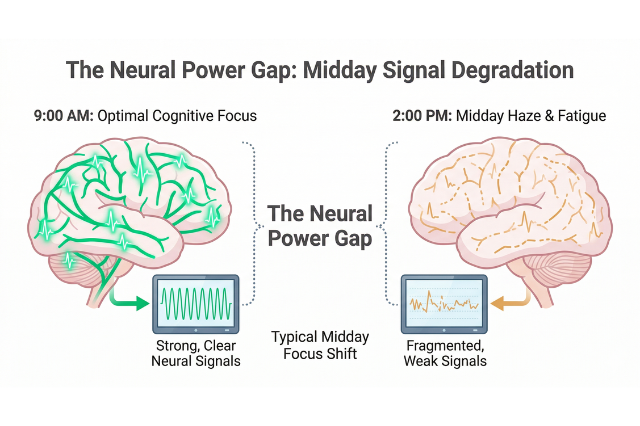
This signal degradation is something researchers are actively studying. It is a physical reality. Trying to ignore it is like trying to drive a car with no fuel. It only leads to burnout.
Early research suggests that supporting the brain’s recovery and metabolic balance during these windows can noticeably shift the experience of afternoon haze.
The ‘Neural Resilience Protocol’: Reclaiming Your Afternoon
Many high-performers over 50 move beyond stimulants. They focus on resourcing.
The Neural Resilience Protocol focuses on providing the brain with the specific compounds it needs to maintain signal clarity when the day gets heavy.
Alpha GPC and Huperzine A are associated with supporting healthy acetylcholine levels. Alpha GPC provides the raw material. Huperzine A helps protect it. Many describe this as a feeling of “mental grip” that stays steady even after lunch.
Ginkgo Biloba may support healthy cerebral circulation. This ensures your prefrontal cortex is not starved of oxygen during the “Brain Tax” window.
Lion’s Mane and Bacopa Monnieri are associated with the health of neural connections. Users report that within a few weeks of consistent use, the afternoon transition feels noticeably smoother.
Phosphatidylserine may support neural fluidity. This allows signals to move cleanly even when metabolic waste starts to accumulate. It makes the afternoon feel less like pushing through mud.
L-Theanine supports a state of calm focus. It removes the anxious edge that often accompanies being mentally exhausted by 2pm.
The FAQ Reality Check: Addressing the Slump
Q: Is this just because I am getting older? Age is a factor, but it does not fully explain the decline. As we age, our mitochondrial efficiency naturally shifts. Addressing the nutritional gap can help support the function your brain is actually capable of.
Q: Will another cup of coffee help? Coffee only blocks the feeling of tiredness. It does not provide the fuel. Over-relying on it can interfere with function over time. It is a temporary mask for a biological deficit.
Q: How fast do behavioral changes work? Small habits, like 16 ounces of water before noon, work today. However, many describe the deepest shifts occurring within a few weeks of consistent nutritional support.
Customized High-Stakes Conclusion
Imagine your day without the 2pm wall.
Imagine having the same mental energy for your family at 6pm that you had for your emails at 9am.
Being mentally exhausted by 2pm is not an inevitable part of life. It is often a signal that your brain may be running at a deficit.
When you address that deficit, the afternoon stops being a battle. It becomes your most productive time.