
The Contrast: Two Versions of the Same Person
Picture yourself at 35.
You could sit down at your desk and just go. No warm-up. No negotiating with your own brain. You’d open the document, find the thread and stay on it for hours without losing your place.
Meetings felt manageable. Complex problems felt engaging rather than exhausting.
Now picture yourself today.
You open the document. You read the first paragraph. Something pulls your attention sideways. You check something quickly. You come back. You reread the first paragraph.
Twenty minutes have passed and you’ve barely started.
It’s not that you care less. You care just as much. It’s not that the work matters less. It matters more. And it’s definitely not laziness. You’re working harder than ever just to produce the same output.
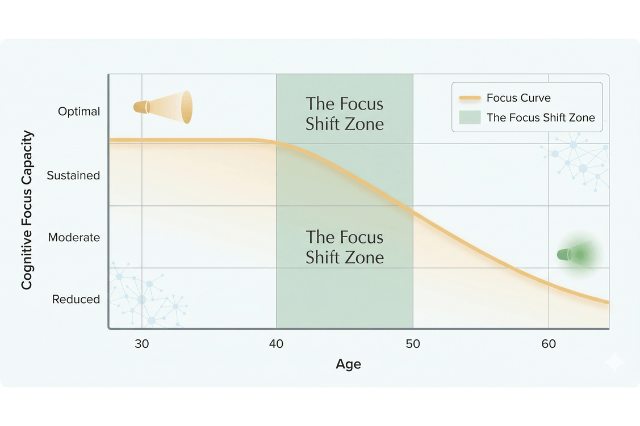
Something changed. Not your character. Not your discipline. Something biological shifted, quietly, somewhere in your late 30s or early 40s. And most people never find out what it actually was.
The Science Deep-Dive: What Focus Actually Requires
Look, here’s the deal: sustained focus is not a personality trait. It’s a physiological state that requires specific biological conditions to exist.
For your prefrontal cortex, the part of your brain responsible for sustained attention and the suppression of distraction, to function at its best, it needs:
● Adequate acetylcholine: The neurotransmitter most directly tied to attention and working memory.
● Sufficient dopamine signaling: To maintain the motivational drive that keeps you on task.
● Stable cerebral blood flow: To deliver oxygen and glucose to active neural areas in real time.
● A cleared metabolic baseline: So accumulated cognitive waste isn’t slowing signal transmission.
● Mitochondrial energy output: Sufficient to sustain prefrontal engagement across a full workday.
Most 35-year-olds have all five in relative abundance. Most 45-year-olds are running deficits in at least two or three. Not because something went wrong. But because natural biological changes have quietly shifted the conditions your focus depends on.
The Focus Thief: What’s Actually Changed Since Your 30s
The experience of declining focus after 40 isn’t one thing. It’s the compounding effect of several biological shifts happening simultaneously.
The Acetylcholine Decline
Acetylcholine is the neurotransmitter your brain uses to direct and sustain attention. When acetylcholine signaling is robust, focus feels effortless. You lock onto a task and stay locked.
When it’s lower, focus becomes fragile. You can still concentrate, but it requires active effort to maintain. Every interruption costs more. Recovery from distraction takes longer.
Acetylcholine levels and the efficiency of signaling naturally change with age. The shift typically becomes noticeable in the early-to-mid 40s. It’s subtle enough that most people attribute it to stress or screen time.
The Prefrontal Energy Gap
Your prefrontal cortex is the most energy-demanding part of your brain. All high-level tasks are extraordinarily expensive in terms of cellular energy.
As mitochondrial efficiency naturally shifts with age, the prefrontal cortex is often the first area to show the effects. It has the highest energy requirements and the thinnest margin for supply disruption.
The result is what researchers sometimes call prefrontal fatigue. This is the experience of focus degrading under sustained demand, specifically in the afternoon, that most adults over 40 recognize immediately.
The Metabolic Haze Factor
Your brain produces metabolic byproducts during every cognitive process. Under optimal conditions, your brain has a natural clearing system that is believed to be most active during deep sleep.
When that cycle is incomplete, accumulated metabolic haze slows signal transmission across the board. Focus is particularly affected because it depends on fast, clean signaling between the prefrontal cortex and the areas it’s directing.
The ‘Neural Resilience Protocol’: What High-Performers Are Actually Doing
The people in your professional world who maintain sharp, sustained focus well into their 50s and 60s are almost never doing it on willpower alone.
They’ve found the right behavioral and nutritional inputs. The Neural Resilience Protocol addresses the specific biological shifts behind declining focus through seven targeted compounds.
Huperzine A is associated with maintaining healthy acetylcholine levels by inhibiting the enzyme that breaks it down. Early research suggests it may support the kind of sustained attentional control that makes staying on a cognitive thread feel less like fighting upstream.
Alpha GPC is associated with mental drive and prefrontal cortex function. It provides choline in a form that crosses the blood-brain barrier effectively. Users report a noticeable improvement in the quality of their focus under sustained demand.
Lion’s Mane Mushroom may support Nerve Growth Factor production, associated with the health of neural connections. Many users report that their mental warm-up period feels more efficient and the resistance to starting work reduces over time.
Bacopa Monnieri may support working memory and help reduce the cognitive impact of chronic stress. When the stress-driven cognitive interference is lower, the prefrontal cortex has more resources available for the task at hand.
Ginkgo Biloba may support healthy cerebral circulation, which directly affects how efficiently the prefrontal cortex receives the oxygen it needs. Many describe the subjective experience as afternoon focus degradation becoming less predictable.
Phosphatidylserine may support neural fluidity and the efficiency of signal transmission. Users consistently describe it as making tasks feel less like pushing through resistance.
L-Theanine supports calm focus. A state of relaxed alertness that allows the prefrontal cortex to engage without the anxiety-driven cognitive interference that often accompanies high-demand focus attempts.

The Focus Survival Guide: What to Do This Week
You don’t need to overhaul your life. You need to make targeted changes that work with your biology instead of against it.
● Stop fighting the afternoon: Prefrontal fatigue is real. Protect your sharpest hours (typically 9 to 11 AM) for the work that requires your best focus. Use the afternoon for administrative work.
● Build genuine transition gaps: Between every major cognitive task, take three minutes of complete disengagement. No phone. No email. This allows the prefrontal cortex to partially reset.
● Address the nutritional baseline: One dropper of the Neurodyne formula held for 30 seconds each morning delivers all seven compounds before the demands of the day begin.
● Protect the morning hydration window: Sixteen ounces of water before your first coffee costs nothing and measurably affects the quality of your morning focus.
Many users report that combining these four inputs consistently produces a noticeable shift in focus quality within a few weeks of consistent use.
The Question Worth Sitting With
How much of the frustration you carry about your focus is actually frustration with yourself?
The voice that says you should be able to concentrate better. That you’re undisciplined or not trying hard enough. That younger you could do this, so why can’t current you?
That voice is working from the wrong diagnosis. Current you is dealing with biological conditions that 35-year-old you didn’t have. Acetylcholine changes. Prefrontal energy shifts. Metabolic accumulation.
The more useful question isn’t “why can’t I focus?” It’s “what does my brain need that it’s not currently getting?”
The answer to that question is more specific and more hopeful than most people realize.