
The Invisible Wall at 2 PM
You know the feeling.
You had a productive morning. You tackled your emails. You finished a major report. You felt in control.
Then you ate lunch.
Thirty minutes later, the wall appears. The screen in front of you feels slightly blurry. Your ability to process complex sentences simply vanishes.
You reach for a second or third cup of coffee. You try to power through. But your brain has other plans. It feels like the power has been cut to your prefrontal cortex.
Most people blame the sandwich they just ate. They call it a food coma. But for many adults over 40, this isn’t just about digestion. It is about a specific biological resource gap that your afternoon coffee cannot fix.
The ‘Science Deep-Dive’: The Acetylcholine Drain
Look. Here is the deal.
Your prefrontal cortex is the CEO of your brain. It manages your focus, your decision-making, and your emotional control.
This area is incredibly expensive to run. It requires a constant supply of energy and a specific neurotransmitter called acetylcholine.
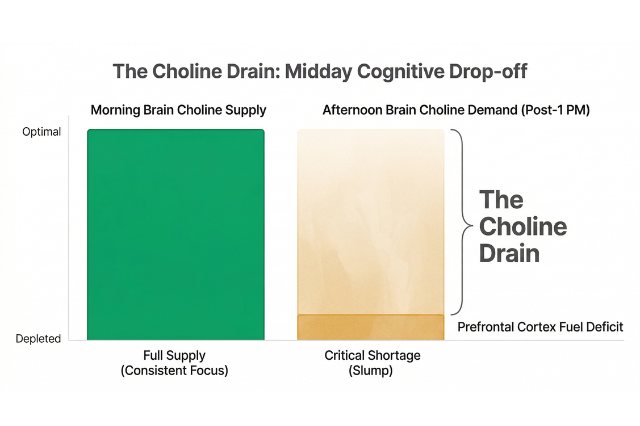
By the time you reach 2 PM, your morning’s work has already depleted a significant portion of your acetylcholine reserves. If your brain cannot replenish this supply fast enough, the system begins to throttle.
This is one of the key reasons your brain can feel like it shuts down after lunch. It is not a lack of willpower. It is a lack of chemical fuel.
This drain is something researchers are actively studying. The gap between what your prefrontal cortex demands and what your body can supply becomes too large to ignore.
Many describe the subjective experience as a literal haze. Signal transmission slows. Thoughts feel like they are reaching through static.
It is a biological reality that your behavioral strategies alone cannot resolve.
The ‘Midday Villain’: Why Coffee Makes It Worse
Most of us respond to the slump by doubling down on stimulants.
Caffeine blocks the receptors that tell you that you are tired. It does not actually provide the brain with the resources it needs to function.
In fact, over-relying on caffeine during the afternoon can interfere with function over time. It creates a false alert state while your underlying cognitive resources remain empty.
The result is a brain that is wired but tired. You are awake, but you are not productive. You are staring at the screen, but nothing is happening.

The ‘Survival Guide’: How to Reclaim Your Afternoon
If you want to stop the cycle where your brain shuts down after lunch, you must change how you resource your midday window.
● The Choline Buffer: Ensure your brain has a steady supply of acetylcholine precursors before the slump hits. This prevents the empty tank feeling.
● The Circulation Pivot: Midday fatigue is often associated with reduced cerebral blood flow as the body prioritizes digestion. A five-minute walk or specific nutrients can help re-balance this.
● The Strategic Disengagement: Take ten minutes of zero-input time. No phone. No podcast. This allows the prefrontal cortex to partially reset its metabolic baseline.
● The Hydration Baseline: Dehydration multiplies the feeling of brain fog. Drink 16 ounces of water with your lunch to support signal transmission.
Many describe the subjective experience of these changes as extending the morning. The clarity you had at 10 AM simply stays with you through the afternoon.
The ‘Neural Resilience Protocol’: Resourcing the Slump
Think about the high-performers who seem to be just as sharp at 4 PM as they were at 8 AM. They aren’t superhuman. They are resourced.
The Neural Resilience Protocol addresses the specific biological shifts that cause the afternoon crash.
Alpha GPC and Huperzine A work together to support healthy acetylcholine levels. Alpha GPC provides the raw material, while Huperzine A helps protect it from breaking down too quickly.
Ginkgo Biloba may support healthy cerebral circulation. This ensures that even while your body is digesting lunch, your prefrontal cortex is still receiving adequate oxygen and glucose.
Lion’s Mane Mushroom and Bacopa Monnieri support the brain’s natural maintenance and recovery processes. Many users report that within a few weeks of consistent use, the afternoon fog becomes less predictable.
Phosphatidylserine supports neural fluidity. This allows signals to move cleanly even when you are under a heavy cognitive load. It makes the afternoon feel less like pushing through mud.
L-Theanine provides a state of calm focus. It removes the jittery edge that often comes from trying to fix the afternoon slump with caffeine alone.
The Customized High-Stakes Conclusion
How much more could you achieve if you had an extra three hours of high-level focus every day?
Most people lose those hours between 2 PM and 5 PM. They spend them in a state of low-level haze, waiting for the workday to end.
What I noticed, and what many describe, is that when you address the nutritional gap, the afternoon stops being a battle. It becomes an asset.
Imagine finishing your day with energy left for your family. Imagine not needing a nap at 6 PM just to survive until dinner.
The 60-day satisfaction guarantee means you can test the protocol for yourself. If your afternoons don’t feel noticeably sharper within a few weeks of consistent use, you get your money back.