
When Thinking Itself Feels Like Hard Work
You know the feeling.
Not tired exactly. Not sick. Just… slow.
Every thought takes slightly longer than it should. Simple tasks that used to feel automatic now require a kind of internal effort you can’t quite describe. You start a sentence and it takes a beat to find the end of it. You read something and have to go back. Twice. You sit down to work and spend the first twenty minutes just trying to get your brain to actually engage.
It feels like trying to run through water. Or mud. Everything moves, but nothing moves fast enough. And the worst part isn’t the slowness itself. It’s that you remember what it felt like when it wasn’t like this.
There was a version of you that could sit down and just go. No warm-up. No friction. The thoughts came and the words followed and the work got done. That version of you didn’t have to fight for access to their own mind.
Here’s what that shift is telling you: it’s not personality. It’s not laziness. And it’s not an irreversible sign of what comes next.
It’s biology. And biology responds to the right inputs.
The ‘Neural Sludge’ Problem Nobody Talks About
Look, here’s the deal: the experience of mental sluggishness has a physiological basis. And it’s more addressable than most people realize.
Most people who feel this way have been told some version of “you’re just stressed” or “you need more sleep” or “it’s just your age.” And while none of those things are wrong exactly, they also don’t explain the mechanism. And without understanding the mechanism, you can’t actually address it.
Here’s what’s most likely going on.
The Metabolic Haze Behind Daily Brain Fog
Your brain generates cellular waste as a byproduct of normal cognitive activity. Every thought, every decision, every memory retrieval leaves behind metabolic byproducts that need to be cleared. Your brain has a dedicated system for this. It runs primarily during deep sleep.
The problem is that most Americans over 40 aren’t completing this clearing cycle consistently. So the haze doesn’t fully lift. It accumulates. Layer by layer, day after day, it settles around the neural pathways responsible for:
● Processing speed (how fast you form and retrieve thoughts)
● Working memory (how long you can hold an idea before it slips)
● Executive function (how easily you initiate and sustain focused work)
● Verbal fluency (how smoothly words move from thought to speech)
Users report the experience as exactly what you might expect from a system running under accumulated load. Slow. Sticky. Like every cognitive process has to push through something that wasn’t there before.
The Energy Deficit Behind the Fog
Now, this part is wild.
Your brain accounts for roughly 20% of your total caloric expenditure despite being only 2% of your body weight. It runs on ATP, the cellular fuel your mitochondria produce. And mitochondrial efficiency naturally shifts over time. The same cognitive workload that felt effortless at 35 may now be drawing on a significantly leaner energy budget.
The result is something that feels less like fatigue and more like resistance. Like the accelerator is working but the engine isn’t delivering full power. You’re trying. The effort is real. But the output isn’t matching it. And that gap is exhausting in its own right.
The Stimulation Trap
The kicker? Most people’s response to mental sluggishness makes it worse.
● More coffee (masks the signal without addressing the cause)
● More screen time (adds cognitive load rather than reducing it)
● Pushing through without breaks (depletes reserves faster)
● Skipping sleep to catch up on tasks (disrupts the brain’s natural clearing cycle)
Each of these is completely understandable. Each of them is also a short-term solution that compounds the underlying problem over time.
The ‘Neural Resilience Protocol’: Addressing the Sludge at the Source
Anyway, here’s what the performance research actually points toward.
The experience of mental sluggishness, that running-through-mud feeling, is not primarily a motivation problem. It’s a resource problem. And resource problems have resource solutions.
The Neural Resilience Protocol is a targeted combination of seven neuro-nutrients studied for their potential to support the specific biological processes that clear metabolic haze, promote healthy neural energy production and maintain the kind of clean signal transmission that makes thinking feel effortless again.
Clearing the Pathways
Lion’s Mane Mushroom may support Nerve Growth Factor production, a protein associated with the health and responsiveness of neural connections. Early research suggests consistent use may contribute to a gradual improvement in cognitive fluency. Users describe the shift as thoughts feeling less sticky. Less resistance between intention and execution.
Bacopa Monnieri is studied for its potential to promote memory retention and support cognitive performance under chronic stress. The running-through-mud sensation is often most acute when mental load is high and recovery is incomplete. Bacopa may help address the stress-driven component of that experience. Users report noticing a difference in how reliably their thoughts stay accessible under pressure, within a few weeks of consistent use.
Ginkgo Biloba may support healthy cerebral circulation, which matters enormously for cognitive speed. When blood flow to active neural areas is well-supported, the delivery of oxygen and nutrients to working brain tissue improves. Many users describe a reduction in that heavy, effortful quality of thinking over time.
Restoring the Signal
Huperzine A is associated with maintaining healthy acetylcholine levels, the neurotransmitter most directly tied to attention, working memory and cognitive initiation. The struggle to “get your brain to start” in the morning is closely tied to acetylcholine availability. Early research suggests Huperzine A may support the kind of clean cognitive startup that makes the first hour of the day feel less like wading through resistance.
Alpha GPC is associated with mental drive and sustained prefrontal cortex engagement. Not a spike of energy. A steady, clean current of focus that supports you through a long task without the mid-task drop-off that turns 30 minutes of work into 90.
Phosphatidylserine may support neural fluidity, the ease with which signals move between neurons. Think of it as reducing the friction in the system. When neural fluidity is well-supported, the gap between thinking something and expressing it narrows. The mud gets thinner.
L-Theanine rounds out the stack with calm focus. A state of relaxed alertness that prevents the overstimulation that can actually worsen cognitive friction. Users report the experience of the full stack as smooth and sustainable. Nothing forced. No jitteriness. Just a quiet, reliable reduction in the resistance they’ve been pushing through.
Together, these seven compounds form the 7-Ingredient Cognitive Shield. Early research suggests consistent daily use may support the Deep-Cycle Cognitive Refresh process, promoting the natural clearing of metabolic haze and healthier neural signal transmission over time.
If the running-through-mud sensation has become your daily baseline, the most likely explanation isn’t that your brain is failing. It’s that it’s running low on specific resources it needs to do its job cleanly. In recent user feedback, a majority reported noticing meaningful shifts in cognitive ease within a few weeks of consistent use. For many, the first change they noticed was simply that thinking felt lighter.

The ‘Friction-Free Morning’ Protocol
You don’t need more willpower. You need less resistance.
The goal of this routine isn’t to add more to your morning. It’s to remove the friction that’s making your brain work harder than it needs to from the first hour of the day.
Step 1: Front-load the hydration. Your brain is roughly 75% water. After eight hours without fluid, even mild dehydration (1-2%) measurably slows processing speed and working memory. Sixteen ounces of water before your phone, before coffee, before any cognitive demand. This single step reduces starting friction more than most people expect.
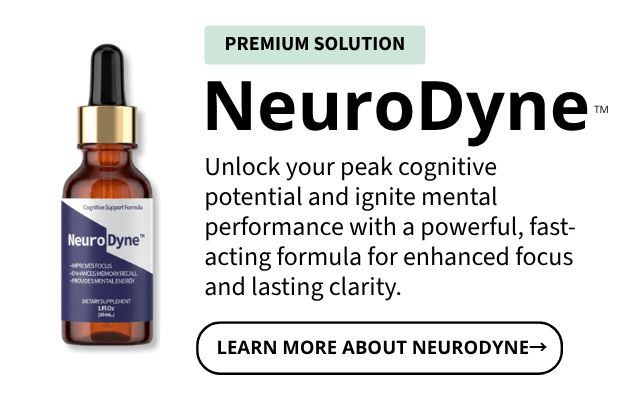
Step 2: The 2-minute nutrient window. One dropper of the Neurodyne formula under the tongue, held for 30 seconds. A second dropper in water. Done. All seven compounds in precise, bioavailable concentrations, delivered before the cognitive load of the day begins. Not added on top of an already heavy schedule. Built into the two minutes before it starts.
Step 3: The pre-2 PM reset. Ten minutes away from every screen, every input, every demand. Before the afternoon slowdown hits. Walking, sitting quietly, no audio. This is when your brain consolidates the morning’s working memory and clears enough cognitive space to perform cleanly through the second half of the day. The people who report the sharpest afternoon thinking almost always do this consistently.
The running-through-mud feeling is often most severe in the afternoon, when cognitive resources are lowest and accumulated haze is highest. Many users report that the combination of morning hydration, the daily formula and a deliberate mid-day reset makes the heaviest part of the afternoon feel meaningfully lighter within a few weeks of consistency.
What It Feels Like When the Mud Clears
Users who stay consistent with the protocol describe a specific kind of shift.
Not a sudden jolt of energy. Not a dramatic transformation. Something quieter and more useful than that.
They sit down to work and start immediately, without resistance. The brain fog that used to define their mornings isn’t setting the tone anymore.
In conversations, they’re present in a different way. They’re not half-listening while the other half of their brain scrambles to stay on track. They’re actually there. Following the thread. Contributing without effort.
At the end of the day, they still have something left. Not just the absence of exhaustion, but actual cognitive availability. For the people who matter. For the things that require real presence.
That’s what users report when the metabolic haze is being managed daily and the 7-Ingredient Cognitive Shield is supporting the results it was designed for over time.
The mud isn’t permanent. The resistance isn’t inevitable. It’s a signal that your brain is asking for something specific.
The 60-day satisfaction guarantee means the only risk is continuing to push through the mud for another two months without trying something different.