
The Quiet Panic of a Blank Slate
It happened on a Tuesday.
I was in the backyard. My grandson, Leo, was running toward me with a drawing he’d just finished. I opened my mouth to cheer for him. I wanted to say “Great job, Leo.”
The first two words came out fine. Then, nothing.
The name was gone. It didn’t just slip. It evaporated. I stood there looking at a face I’ve known since the second he was born, and for a terrifying three seconds, I was a stranger to my own memory.
That moment — when you’re forgetting names suddenly — stays with you. I laughed it off. I called him “buddy” instead. He didn’t notice.
But I did.
That night, I couldn’t sleep. You start doing the mental math. You wonder if this is the beginning of a long, slow goodbye to yourself. You replay every time you’ve lost your keys or forgotten why you walked into the kitchen.
Look, here’s the deal: forgetting a loved one’s name is a specific kind of heartbreak. It’s a wake-up call. “Just getting older” is no longer a sufficient explanation. You feel a heavy, invisible pressure in your chest. You wonder who is going to go missing next.
But after the panic subsided, I started looking for answers. Real ones. And what I found changed how I look at my brain entirely.
The ‘Name-Recall Gap’: What’s Really Causing It
Most people think memory is like a filing cabinet that just gets too full. That’s a common misconception.
The kicker? Your brain is actually incredible at storage. The problem isn’t that the information is gone. The problem is the retrieval system is lagging. Think about your brain as a high-speed fiber optic network. Over time, “debris” starts to settle on the lines.
What I discovered is that this breakdown in neural communication usually stems from three specific areas:
● The Clearing Cycle Failure: Your brain has a plumbing system that flushes out metabolic waste during sleep. If that system is sluggish, the waste stays. It gums up the works.
● The Neuro-Nutrient Deficit: Your brain needs specific raw materials to build the bridges between neurons. If you’re low on these, the signal drops mid-sentence.
● Stress-Driven Interference: High levels of cortisol can interfere with hippocampal function over time. This is the part of your brain responsible for names and dates.
Anyway, I realized I wasn’t losing my mind. I was losing my bandwidth. My brain was trying to work, but it was running on a depleted battery with a clogged filter.
The Neural Resilience Protocol: Rebuilding the Signal
Now, this part is wild. I spent weeks diving into nutritional neuroscience. I found that most “memory pills” are just overpriced caffeine. They don’t fix the bridge. They just make the bridge-builder work faster while the bridge is still broken.
The real shift comes from a specific combination of neuro-nutrients that address the root cause of the recall gap. This is the Neural Resilience Protocol.
It’s not about “fixing” a disease. It’s about supporting the biological infrastructure of your memory. Here is what the research actually points toward:
● Nerve Growth Support: Lion’s Mane Mushroom is a key player. Early research suggests it may support the health of the connections themselves.
● Neural Signal Stability: Huperzine A is associated with maintaining acetylcholine. That’s the “messenger” chemical. Without it, names simply don’t cross the finish line.
● Cerebral Circulation: Ginkgo Biloba may help support healthy blood flow, which plays a role in delivering oxygen to active areas of the brain.
I realized that Tuesday afternoon panic was a signal. My brain was asking for a different kind of support. What I noticed, and what many others describe, is a meaningful shift in the ability to recall names and details within a few weeks of consistent use. For many, it’s the first time they felt truly “connected” to their own thoughts again.

The ‘Precision Recall’ Morning Ritual
I didn’t want a complicated life. I just wanted to be able to remember names again. I found that consistency beats intensity every single time.
To stop those recall slips from becoming a daily habit, you need to prime your brain before the day’s stress hits. This is the routine I started using to protect my recall:
● Hydrate the Pathways: I drink 16oz of water before I even look at my phone. Your brain is 75% water. Dehydration may make it harder for your brain to efficiently clear metabolic waste.
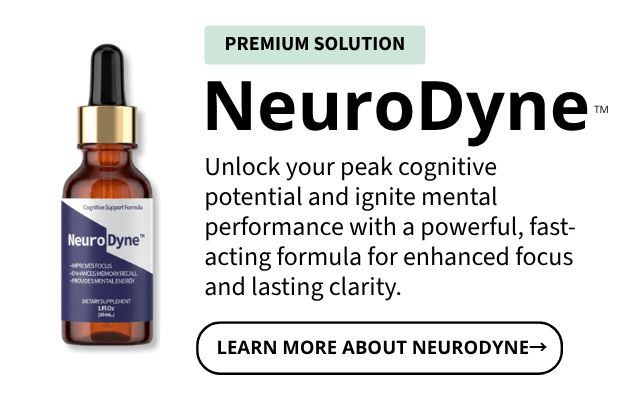
● The 2-Minute Shield: I use the Neurodyne formula immediately. One dropper under the tongue. One in water. This helps deliver all seven bioavailable compounds when my brain is most receptive.
● The 2 PM Memory Reset: I take ten minutes of silence in the afternoon. No screens. No talking. This gives the hippocampus a chance to “archive” the morning’s data so it doesn’t get lost in the afternoon shuffle.
Think about it. We maintain our cars and our homes. Why do we wait for a crisis to maintain the organ that holds our entire life story? After establishing this daily routine, many people notice those “blank stare” moments becoming less frequent.
Remembering the Moments That Matter
After about four weeks of staying consistent, I noticed a change.
I was at the park with Leo again. He was pointing at a bird. I didn’t have to “reach” for the word “Blue Jay.” It was just there.
I wasn’t just going through the motions. I was actually there.
The static in my head cleared. I felt more present. I wasn’t constantly scanning my brain for the next word. I was just talking.
That’s what I started noticing over time as I stayed consistent. It’s not about becoming a genius. It’s about being yourself again.
“It’s just aging” rarely tells the full story. The recall gap has causes — and in many cases, those causes can be supported. The 60-day satisfaction guarantee means you can find out if your “bandwidth” can be restored without any financial risk.
I never want to feel that Tuesday afternoon panic again. And now, I don’t have to.