
That ‘Tip of the Tongue’ Moment: More Than Just a Bad Day?
It’s a Tuesday morning. Conference room. Twelve people around the table.
Your manager turns to you (in front of everyone) and asks about the project you’ve been running for six weeks. You know this cold. You own this material.
And then.
Nothing.
Your palms go slightly damp. Your eyes drop to your notebook like the answer might appear there. You buy yourself three seconds with a slow nod and a “great question.” The word is right there. Hovering at the edge of your mind like a name you just can’t place. It comes back. Eventually. Half a beat too late.
You laugh it off on the way to the bathroom. Long week. Didn’t sleep great.
But here’s what you won’t say out loud: it happened last Thursday too. You walked into your kitchen and stood there for ten full seconds. Completely blank. Trying to remember why you came in. You called your coworker by the wrong name. Twice. In the same conversation. You reread the same Slack message four times and still couldn’t summarize it if someone asked.
You’re 48. You’re sharp. You run a team, manage a household, keep seventeen plates spinning every single day.
And your brain is starting to feel like it’s working against you.
Let’s be honest. You’ve probably Googled it. Maybe late at night, phone screen glowing in the dark, searching for answers you’d never say out loud. Is this normal? Is something wrong with me?
Here’s what you need to hear: you’re not losing it. You’re not broken. And this has very little to do with your age.
Your brain isn’t broken. It’s being quietly drained by forces most people never think to question.
The Hidden ‘Brain Tax’ Quietly Stealing Your Clarity
Look, here’s the deal: nobody designed the modern American workday with your neurons in mind.
Before you’ve had a single sip of coffee, your phone has already served you seventeen notifications, three news alerts and a passive-aggressive email from accounting that requires an immediate response at 7 AM. Your brain (still warming up, still dehydrated from eight hours of sleep) is already burning fuel it doesn’t have.
Think about it. A typical day for a 45-year-old professional looks like this: a 10-hour workday, 300-plus emails, back-to-back Zoom calls with zero transition time, a Target run on the way home, dinner to figure out, kids’ homework to supervise. And somehow you’re supposed to show up as a fully present human being by 7 PM.
That’s not a lifestyle. That’s a stress test. And your brain is running it every single day on an empty tank.
Your brain is a high-end Tesla. Powerful, sophisticated, built for performance. But right now it’s running on 1% charge. And you keep asking it to merge onto the highway.
Mental Haze Buildup
Here’s the part nobody mentions at your annual checkup.
Every time your brain works (every thought, every decision, every memory you access) it produces metabolic byproducts. Under optimal conditions, your brain naturally clears this cognitive buildup during deep sleep, through a cleansing process that researchers have been studying closely over the past decade.
The problem? Most Americans over 40 aren’t getting the deep, restorative sleep their brain needs to complete that cycle. So the haze accumulates. Day after day, week after week, it settles around your neural pathways like a slow fog. Making everything slightly harder to access. Words come slower. Names take longer. The mental sharpness you used to take for granted starts requiring real effort.
Users report noticing this as a kind of “mental friction.” The sense that your thoughts are moving through something thick rather than flowing freely.
The Cellular Energy Gap
Your brain runs on ATP. That’s the energy currency produced by your mitochondria. And your brain is the most energy-hungry organ in your body, consuming roughly 20% of everything you eat even though it’s only 2% of your body weight.
Now, this part is wild. As we get older, mitochondrial efficiency naturally changes. Your brain’s cellular “power plants” may produce less ATP per cycle. Which means the same workload that felt manageable at 32 can leave you running on fumes by early afternoon.
That’s the 3 PM crash at the water cooler. Not weakness. Not poor discipline. A real, physiological cellular energy gap. Your brain’s power supply struggling to keep pace with the demands you place on it every single day.
Modern Decision Fatigue
Every decision you make draws from the same finite pool of mental resources.
The kicker? Your brain doesn’t distinguish between approving a six-figure budget and deciding what to order at Starbucks. They all cost something. Every notification, every context switch, every micro-choice chips away at the same cognitive battery.
By the time you hit the water cooler at 3 PM, you’ve made hundreds of decisions since you woke up. You’re not unfocused. You’re not undisciplined. You’re depleted. And you’ve been running that way so long it just feels normal.
The ‘Neural Resilience Protocol’: What High-Performers Are Doing Differently
Anyway, here’s where it gets interesting.
While conventional approaches focus on managing cognitive struggles after they appear, a quieter conversation has been building in neuroscience and performance research. It’s centered on what you can do proactively. On giving your brain the specific nutrients it needs to support healthy neural communication, promote natural cognitive clearing and maintain the cellular energy levels that keep you sharp throughout the day.
It’s not about pushing harder. It’s about giving your brain the right raw materials.
Researchers and high-performance coaches call this the Neural Resilience Protocol. A specific combination of neuro-nutrients that may support the prefrontal cortex (the part of your brain most responsible for focus, recall and executive function).
Supporting Healthy Neural Pathways
Lion’s Mane Mushroom is the most researched functional mushroom for cognitive support. Early research suggests it may support the production of Nerve Growth Factor, a protein associated with the maintenance of healthy neural connections. Users report noticing a gradual lift in mental clarity. Not a sudden jolt. A steady clearing, like fog burning off on a calm morning. You don’t notice it happening. You just notice that you’re thinking faster.
Bacopa Monnieri has centuries of traditional use and is now studied for its potential to promote memory retention and support healthy cognitive function under stress. It takes three to four weeks to build in your system. But users report noticing meaningful differences in word recall and sustained mental stamina once it does.
Huperzine A is associated with maintaining healthy acetylcholine levels, the neurotransmitter most closely linked to learning and memory formation. Early research suggests it may support sharper recall and faster information access throughout the day.
Alpha GPC is associated with mental drive. The kind of sustained, clean focus that lets you stay locked in on a complex task without the restless edge that stimulants bring.
Natural Cognitive Clearing
Ginkgo Biloba is one of the most studied botanical compounds for brain support. The science focuses on its potential role in promoting healthy cerebral circulation, which may support the brain’s natural ability to deliver nutrients to active neural areas and clear the metabolic haze that accumulates during intensive cognitive work.
Phosphatidylserine may support neural fluidity, the flexibility of cell membranes that allows neurotransmitters to move between neurons efficiently. Think of it as promoting the natural flow of cognitive signals that can slow down under chronic stress and daily overload.
The Bioavailability Factor
Here’s the reality most people don’t consider.
You cannot get meaningful amounts of these seven compounds through diet alone. Not even close. To approach the concentrations associated with cognitive benefit in research, you’d need to consume functional mushrooms by the pound and botanical extracts in quantities that simply don’t exist in whole food form.
Raw ingredients (even high-quality ones) lack the clinical concentration that a specialized extraction process delivers. A precisely formulated supplement provides each compound in a stable, bioavailable form that your body can actually absorb and use. Every morning. No guesswork. No prep time.
L-Theanine, the seventh compound in this protocol, supports calm focus, a state of relaxed alertness associated with productive, sustained concentration. Users report that it smooths the experience of the full stack, promoting the kind of steady mental clarity that lets you stay sharp without the jittery edge.
Together, these seven compounds form what users are calling the 7-Ingredient Cognitive Shield. A daily routine that early research suggests may support the brain’s own Deep-Cycle Cognitive Refresh process, promoting the natural clearing of metabolic haze and supporting healthy neural communication throughout the day.

The 5-Minute Morning Routine for Lasting Sharpness
You don’t need a 5 AM alarm or a $400 blender. The most effective brain-support routines are almost embarrassingly simple. Because simple is what actually gets done when your calendar is already full.
Hydration first. Before your phone. Before coffee. Before anything. Drink 16 ounces of water. Your brain is roughly 75% water. After eight hours of sleep without hydration, you’re mildly dehydrated before your day has even started. Research associates even mild dehydration with measurable impacts on recall, focus and processing speed. This is the simplest cognitive support available. Most people skip it entirely.
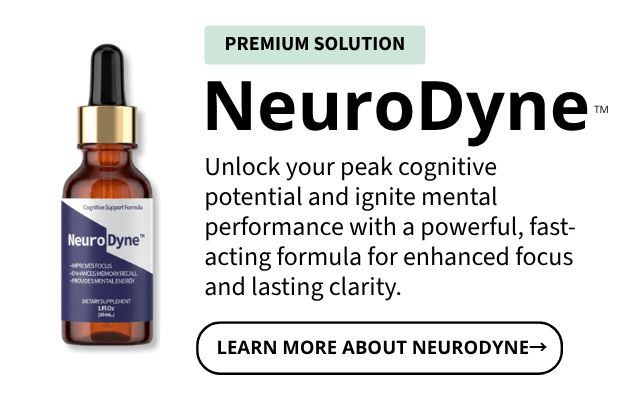
Targeted nutrients. This is where the Neurodyne protocol earns its place in the routine. One dropper under the tongue. Hold for 30 seconds. Swallow. Then a second dropper in water. That’s it. Under five minutes, built into the routine you already have. All seven compounds, in precise concentrations, delivered in a form your brain can actually use.
A real break before 3 PM. Step away from every screen for 10 minutes. Walk to the water cooler and back. Sit somewhere quiet. No podcast, no scrolling. This is when your brain consolidates what it’s been processing and gets ready for the second half of the day. The people who are sharpest at 5 PM are almost always the ones who took real breaks. Not the ones who powered through without stopping.
Reclaiming Your Edge: The Best Version of You Starts Now
Here’s what users report noticing around week four of the protocol.
They’re hitting deadlines without the usual mental scramble. In afternoon calls, they’re remembering names, numbers and context without checking their notes. They’re not blanking. They’re not stalling. They’re just present.
At 6 PM, when their kids ask for help with homework or their partner wants to actually connect, they’ve got something left. Not just physically in the room. Actually there. Actually engaged. Actually themselves again.
That’s not marketing copy. Those are the experiences users report when the cognitive buildup starts clearing, when healthy neural communication is supported daily, when the 7-Ingredient Cognitive Shield is doing what it’s designed to do.
The afternoon fog isn’t permanent. The 3 PM crash isn’t inevitable. The tip-of-the-tongue moments aren’t just “getting older.”
They’re signals. And signals, when you know how to read them, point toward solutions.
The 60-day satisfaction guarantee means you can try the full protocol without risk. The only real question is how many more foggy afternoons you’re willing to accept before you decide to do something about it.